
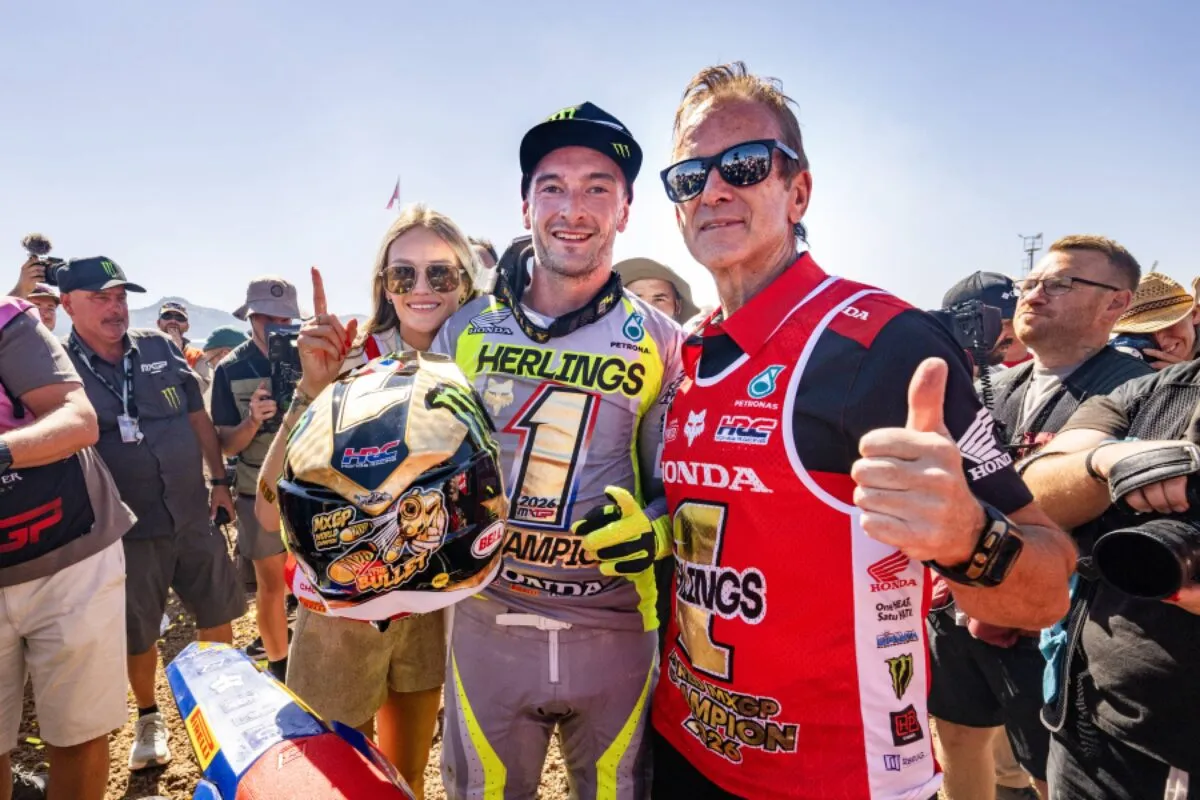
Jeffrey Herlings Wins Sixth World Title: The Dutch Legend Is Still Not Finished
Jeffrey Herlings has won his sixth Motocross World Championship, adding another extraordinary chapter to a career that is already rewriting the MXGP record books. Fourteen years after claiming his first world title in 2012, the Dutchman secured his latest championship with his 123rd Grand Prix victory, a milestone that puts him level with Joel Robert on six world titles while leaving only Stefan Everts and Tony Cairoli ahead of him in the all-time championship standings.
But perhaps the most revealing part of Herlings' latest achievement was not the number six.
It was the way he went about winning it.
With the championship within reach and injury the only realistic threat to his advantage, Herlings could have approached the weekend conservatively. Instead, he took two holeshots, led every lap and won the Grand Prix.
That tells us something important about where Herlings is in his career. He may now have six world championships and more Grand Prix victories than any rider in history, but he still does not seem interested in simply adding numbers to his CV.
He wants to win.
Six World Titles Places Herlings Among the Greatest Ever
Herlings' first world championship came in 2012, when he was still a teenager and already being talked about as one of motocross' next superstars.
Fourteen years later, he has now reached six premier-level world championships.
That puts Herlings alongside Belgian legend Joel Robert on the all-time list for world titles. Only Stefan Everts, with ten, and Tony Cairoli, with nine, now sit ahead of him.
That is an extraordinary position for a rider whose career has also been defined by setbacks.
Herlings has spent much of his career walking the line between extraordinary speed and the physical consequences of riding at that level. Injuries have repeatedly interrupted his momentum, making his longevity and ability to return to championship-winning form arguably just as impressive as the raw statistics.
Six championships therefore do not simply represent six seasons in which everything went right.
They represent six occasions where Herlings managed to put together enough speed, consistency, resilience and, crucially, health to finish the job.
The 123rd Grand Prix Win Is Almost as Significant
The championship was secured alongside Herlings' 123rd Grand Prix victory, another number that underlines just how far ahead he has moved in the sport's record books.
Winning one Grand Prix requires speed.
Winning dozens requires consistency.
Winning 123 across different generations of riders, different manufacturers, different circuits and different eras of MXGP requires something considerably harder: the ability to remain relevant for an exceptionally long time.
That may ultimately be one of the most impressive aspects of Herlings' career.
The riders he competed against as a young factory KTM rider are not necessarily the same riders he is battling today. The bikes have evolved, the championship has changed, and a new generation has arrived looking to take his place.
Herlings has remained the constant.
Herlings Could Have Played It Safe, He Chose Not To
There was an interesting contradiction in Herlings' comments after clinching the championship.
He admitted that he had been extremely nervous in the build-up to the weekend. His championship advantage meant that the biggest danger was not necessarily another rider beating him. It was something happening to him.
Given Herlings' history of serious crashes and injuries, that fear was understandable.
Yet once the gates dropped, the nerves disappeared.
Two holeshots. Every lap led. Another Grand Prix victory.
That is the part of this championship that deserves attention.
Herlings did not need to demonstrate that he was the fastest rider in the field. He had already built the championship advantage. But when the moment arrived, he was still capable of producing exactly the performance required.
Herlings himself described that ability as something champions develop, knowing when to switch off the nerves and simply deliver.
That experience could become increasingly important as he gets older.
The Biggest Threat to Herlings Was Never a Lack of Speed
There is an obvious question whenever Herlings adds another major achievement to his career: how much longer can he keep doing this?
The answer is impossible to know, but this championship has provided a fairly convincing response to anyone suggesting that his competitive fire is fading.
It clearly has not.
In fact, one of the most revealing things Herlings said was that he was already thinking about the next Grand Prix almost immediately after securing the title.
That mentality separates him from a rider who is simply trying to extend a legacy.
Herlings appears to be trying to extend his winning record.
He wants more Grand Prix victories. More race wins. More opportunities to increase numbers that are already difficult to comprehend.
And that changes the way the rest of the MXGP field has to approach him.
For the Rest of MXGP, the Championship Is Not Getting Easier
A new generation of MXGP riders has spent the last few seasons trying to close the gap to the established stars.
Herlings' sixth championship shows just how difficult that task remains.
It is one thing to beat Herlings in a moto.
It is another to beat him across an entire championship.
The distinction is important.
There will always be individual weekends where younger riders have the speed to challenge him. There will be races where circumstances, injuries, starts or track conditions change the picture completely.
But over the length of a world championship, the target is consistency.
And Herlings has just demonstrated once again that he still possesses it.
For riders such as Lucas Coenen, Romain Febvre, Tim Gajser and the other leading MXGP contenders, Herlings' sixth title is therefore more than a celebration of the past. It is a warning about the present.
The next generation cannot simply wait for Herlings' era to end.
They have to take it from him.
The Number 84 May Still Matter More Than Number 1
There is also a fascinating detail surrounding Herlings' plans for next season.
After winning the championship, he was asked whether he would run the number one plate.
The answer was far from straightforward.
Herlings admitted that there is something special about riding with the number one, but also explained that he has become much less interested in the arrogance that can sometimes come with being the champion.
His preferred number remains 84.
That might seem like a small detail, but it actually fits the wider picture of Herlings' career at this stage.
The younger Herlings was known for his enormous confidence and sometimes outspoken personality. The rider standing on top of the MXGP world now appears considerably more reflective.
He knows what he has achieved.
He simply does not feel the need to constantly remind everyone about it.
And perhaps that makes the number 84 more appropriate than number one.
Six Titles Does Not Feel Like the End of the Story
The easiest way to view Herlings' sixth world championship is as the latest entry in a remarkable list of achievements.
But that undersells what is happening.
Herlings is now chasing records that once looked almost untouchable.
Six world championships puts him level with Joel Robert. Nine would put him alongside Tony Cairoli. Ten would bring him level with Stefan Everts.
Those numbers are no longer theoretical targets somewhere in the distance.
Herlings is moving towards them.
Whether he eventually reaches Cairoli's nine or Everts' ten is impossible to predict. Championships depend on far more than speed, particularly at this stage of a career. Health, injuries, bike performance, competition and the relentless physical demands of MXGP will all play their part.
But the fact that the question can even be asked is remarkable.
Fourteen years after his first world championship, Herlings has not become a ceremonial figure from a previous era.
He is still winning Grands Prix.
He is still winning championships.
And he is still looking towards the next race.
My Take: Herlings' Greatest Achievement May Be His Ability to Keep Coming Back
The statistics will dominate the headlines, and rightly so.
Six world championships. 123 Grand Prix victories. A place alongside Joel Robert in the history books.
But for me, the bigger story is the career that sits behind those numbers.
Herlings has had enough injuries and setbacks to derail the careers of several riders. Yet every time the expectation has been that another chapter of his career might be coming to an end, he has found a way back to the front.
That makes this sixth championship different from his first.
In 2012, Herlings was the prodigy proving that he belonged at the top.
Today, he is the veteran proving that the top still belongs to him.
And that is a much harder achievement.
The most exciting part is that Herlings does not sound satisfied.
He has already made it clear that winning the championship does not mean the season is finished. His next objective is to increase the Grand Prix and moto-win records even further.
That is bad news for everyone else in MXGP.
Because the championship may have been decided, but Jeffrey Herlings still has races he wants to win.
And if this weekend is anything to go by, he has no intention of slowing down just because he has another world title in the trophy cabinet.
What Comes Next for Jeffrey Herlings?
The immediate challenge for Herlings is no longer proving that he can win the championship.
It is deciding how far he can push the records before his career eventually comes to an end.
Six titles have moved him level with one of motocross' greatest champions. His 123rd Grand Prix victory has pushed an already remarkable record even further.
Now the questions become even bigger.
Can Herlings reach seven world titles? Can he close the gap to Cairoli and Everts? How high can the Grand Prix victory record go?
Those questions would have sounded unrealistic for almost any other rider.
For Herlings, they are now legitimate possibilities.
And that is perhaps the clearest indication of his place in motocross history.
Jeffrey Herlings is no longer simply one of the greatest riders of his generation. He is now chasing the very highest numbers in the history of the sport, and, remarkably, he still looks hungry for more.