
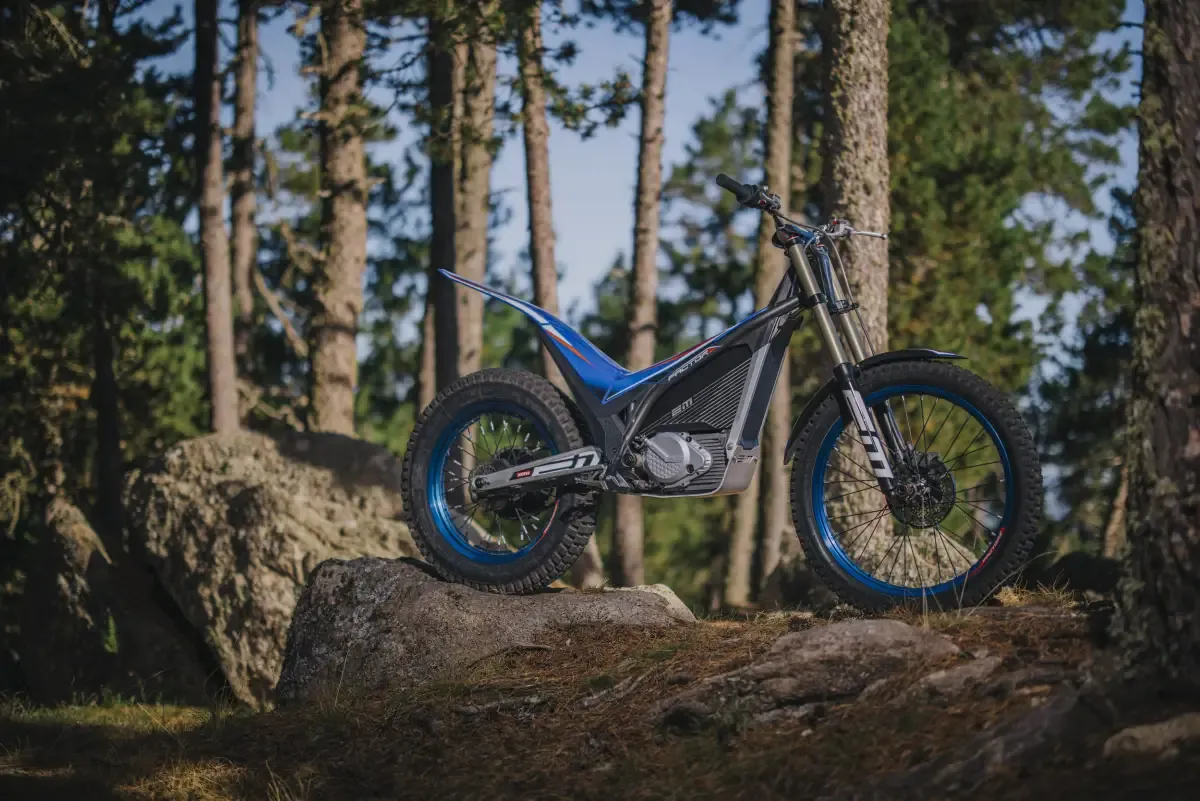
Electric Motion Epure FACTOR-e 2027: New Electric Trials Bike Explained
The 2027 Electric Motion Epure FACTOR-e is a completely new-generation electric trials motorcycle, combining a new high-voltage battery, new chassis, EM-developed powertrain, four-speed gearbox and hydraulic clutch.
But while the specification list makes the FACTOR-e look like a serious competition machine, there is another question that will matter to many potential buyers: who is this bike actually for?
Is the new Electric Motion Epure FACTOR-e a motorcycle aimed primarily at experienced trials riders and competitors, or could it also be a sensible choice for someone learning trials for the first time?
The answer is more complicated than simply calling it a beginner or expert bike.
Electric Motion says the 2027 FACTOR-e has been developed to adapt to different riders, from World Championship competitors to newcomers who want to progress with confidence. The combination of power maps, a four-speed gearbox, hydraulic clutch and adjustable riding position gives the bike considerably more flexibility than the typical electric motorcycle.
However, the specification also tells us that this is a serious trials motorcycle rather than a simple entry-level electric bike.
What Is the Electric Motion Epure FACTOR-e?
The Epure FACTOR-e is Electric Motion's new 2027 electric trials motorcycle.
Electric Motion describes it as the result of a decade of development, with the company drawing on experience from competition and development riders to improve the chassis, powertrain, suspension, electronics and overall riding dynamics.
The FACTOR-e is designed around the idea of combining the characteristics of an electric motor with the control and feel expected from a conventional trials motorcycle.
That is particularly important because trials riding is very different from most forms of off-road motorcycling.
Low-speed control, clutch work, precise throttle inputs, traction and balance are more important than simply having maximum horsepower.
Electric Motion has therefore gone further than simply putting a battery and electric motor into a lightweight off-road chassis.
The FACTOR-e uses a genuine four-speed gearbox and hydraulic diaphragm clutch, giving the rider a more traditional trials riding experience while retaining the characteristics of electric drive.
2027 Electric Motion Epure FACTOR-e: Key Specifications
| Specification | Electric Motion Epure FACTOR-e 2027 |
|---|---|
| Battery | 2.0 kWh high-voltage battery |
| Optional battery capacity | 4.0 kWh using two batteries |
| Maximum power | Up to 18 kW |
| Maximum torque | 1,400 Nm in first gear |
| Maximum engine speed | 14,000 rpm |
| Gearbox | 4-speed |
| Clutch | Hydraulic diaphragm clutch |
| Weight | 73 kg |
| Maximum speed | 85 km/h |
| Claimed maximum range | Up to 3.5 hours |
| Power maps | 3 |
| Road legal | Yes – 125 cm³ equivalent classification listed by Electric Motion |
Specifications supplied by Electric Motion. Actual range will depend heavily on riding conditions, terrain, rider inputs and battery configuration.
The New 2.0 kWh High-Voltage Battery
One of the biggest changes for 2027 is the new battery system.
The Epure FACTOR-e uses a 2.0 kWh high-voltage battery housed inside a newly designed magnesium casing.
According to Electric Motion, the new casing is lighter and more rigid while also allowing the battery to be better integrated into the chassis. The manufacturer says the result is improved agility, energy efficiency and longer-lasting performance.
Perhaps one of the most useful features for trials riders is that the battery remains fully removable.
Electric Motion says it can be removed and swapped in under 60 seconds.
That could be particularly useful for riders who spend long days practising, compete in events or want to carry a spare battery rather than waiting for the motorcycle to recharge.
Can You Fit Two Batteries?
Yes.
Electric Motion says the FACTOR-e can be equipped with two 2.0 kWh batteries, giving the motorcycle 4.0 kWh of available energy.
The company also offers a battery rental programme, meaning riders who only occasionally require additional range do not necessarily have to purchase a second battery outright.
This is one of the more interesting aspects of the FACTOR-e because the same motorcycle can potentially be configured for very different types of use.
A rider practising sections for a couple of hours does not necessarily need the extra weight and capacity of a second battery.
Someone planning longer trail rides may see considerably more value in having additional energy available.
18 kW of Power and 1,400 Nm of Torque
The numbers attached to the FACTOR-e's motor are impressive.
Electric Motion quotes up to 18 kW of power, with the motor capable of reaching 14,000 rpm.
The manufacturer also quotes 1,400 Nm of torque in first gear and a power-to-weight ratio of 3.3 kW/kg.
However, it is important not to look at the torque figure in isolation.
Electric motorcycles and geared motorcycles do not always present torque figures in a way that makes direct comparisons particularly useful.
For a trials rider, the more important question is how controllable that torque is at the rear wheel.
That is where the combination of the electric motor, power maps, gearbox and clutch becomes particularly important.
Why Does an Electric Trials Bike Need a Gearbox?
This is one of the most interesting features of the FACTOR-e.
Electric Motion has not followed the simplest approach of using a single-speed transmission.
Instead, the bike gets a four-speed gearbox.
The company says each gear has a particular purpose:
- First gear: Maximum precision and responsiveness for slow technical sections.
- Second gear: Greater control and traction on faster natural terrain.
- Third gear: A balance between trials riding and trail use.
- Fourth gear: Higher speed and improved efficiency during longer transfers.
For an experienced trials rider, this could be one of the FACTOR-e's biggest advantages.
Gear selection is part of the technique of traditional trials riding, and having four ratios allows the rider to choose how the motor delivers its performance rather than relying entirely on electronic control.
For a beginner, however, the gearbox does introduce another skill to learn.
That does not make the bike unsuitable for novices, but someone completely new to motorcycles may find a simpler electric trials bike easier to understand initially.
The Hydraulic Clutch Is a Big Deal
The FACTOR-e also features a hydraulic diaphragm clutch with a triple-disc arrangement.
Electric Motion says the system is designed to provide precise control and strong performance on demanding obstacles.
For experienced trials riders, this is potentially one of the most important parts of the motorcycle.
Clutch control is fundamental to advanced trials riding.
Being able to precisely control the connection between the motor and rear wheel can make the difference between smoothly climbing an obstacle and losing traction halfway through it.
An experienced rider should therefore immediately understand why Electric Motion has gone to the trouble of retaining a proper clutch system.
For a complete novice, however, the clutch becomes another control to learn.
That is not necessarily a disadvantage, but it means the FACTOR-e should not be confused with a simple learner-focused electric motorcycle.
Three Power Maps
The Epure FACTOR-e has three power maps, allowing the character of the motorcycle to be adjusted to suit different riding situations.
This is arguably one of the features that makes the bike more accessible to less experienced riders.
A novice does not necessarily need to use the most aggressive setting while learning basic throttle control, balance and body positioning.
An experienced rider, meanwhile, can take advantage of the more performance-focused characteristics of the motorcycle when tackling difficult sections.
This gives the FACTOR-e a broader operating window than a motorcycle designed purely around maximum competition performance.
A Completely New Chassis
Electric Motion has developed a completely new chassis architecture for 2027.
The company says the design focuses on mass centralisation and improved handling, with the aim of making the bike quicker through direction changes while maintaining stability over obstacles.
New aluminium tie rods are also used to increase chassis rigidity and improve rider feedback.
The bodywork has become slimmer and the ergonomics have been redesigned to give the rider more freedom of movement.
That matters enormously in trials.
Unlike motocross, where the rider is regularly seated and standing in predictable positions, a trials rider is constantly moving around the motorcycle.
Being able to shift body weight quickly is fundamental to balancing the bike over rocks, steps, climbs and technical sections.
Adjustable Riding Position
The FACTOR-e gets new multi-position triple clamps with four different adjustment positions.
This allows the riding position to be altered according to the rider's body size and preferred riding style.
That is a useful feature for a bike intended to accommodate such a broad range of riders.
A shorter novice rider and a taller experienced competitor may have very different preferences when it comes to bar position and riding position.
Rather than forcing every rider into the same setup, the FACTOR-e provides some room for adjustment.
The New TFT Display Includes Trial Mode
Another new feature is the integrated TFT display.
Electric Motion has added a dedicated Trial Mode that includes a built-in section timer, allowing riders to see the remaining section time while riding.
That is a feature that will be particularly interesting to competition riders.
Trials is not only about completing obstacles without dabbing; competitive riders also have to manage their time through sections.
Having that information integrated into the motorcycle could make it easier to monitor progress without adding another device to the handlebars.
How Much Does the Epure FACTOR-e Weigh?
The published weight of the 2027 Epure FACTOR-e is 73 kg.
For a trials motorcycle, keeping weight low is critical.
The rider is frequently required to lift, pivot, balance and reposition the motorcycle over obstacles, and every kilogram matters when the bike is being moved manually.
The new battery casing, chassis design and overall weight distribution are therefore just as important as the headline power figures.
Electric Motion's focus on mass centralisation is particularly relevant here because a motorcycle that feels light and balanced can be easier to control than one that simply has a low number on the scales.
What Is the Range of the Electric Motion FACTOR-e?
Electric Motion lists a maximum range of up to 3.5 hours.
However, prospective buyers should treat that number as a maximum manufacturer claim rather than a guaranteed riding time.
Trials riding is extremely variable.
A rider spending a session practising slow technical sections may use energy differently from someone riding faster trail sections in third or fourth gear.
Temperature, terrain, rider weight, riding style and the selected power characteristics will also influence actual battery consumption.
The ability to remove the battery and add a second 2.0 kWh unit is therefore arguably more useful than the headline three-and-a-half-hour figure for serious riders.
Is the Electric Motion Epure FACTOR-e Road Legal?
Electric Motion lists the FACTOR-e as road legal and gives it a 125 cm³-equivalent classification.
This could significantly increase the bike's versatility for riders who need to travel between riding areas rather than transporting the motorcycle exclusively in a van or trailer.
However, prospective UK buyers should always check the exact specification, registration requirements, licensing rules and road equipment of the version supplied to their market before purchasing.
What Suspension Does the FACTOR-e Use?
The 2027 FACTOR-e uses a new TECH rear shock developed with input from Marc Colomer and approved by Gael Chatagno.
Electric Motion says the shock is designed to improve traction and rear-end feel.
It provides rebound adjustment with 24 clicks as well as spring preload adjustment from 1 mm to 10 mm.
The complete suspension system has also been redesigned around the new motorcycle's weight and weight distribution.
For experienced riders, the adjustment range gives more opportunity to tailor the bike to individual riding style and terrain.
For beginners, the standard setup should be more important than spending hours immediately adjusting every setting.
Is the Electric Motion Epure FACTOR-e Good for Beginners?
Yes, but with an important qualification.
The FACTOR-e is potentially suitable for a beginner, but it is not what I would describe as a basic beginner's trials bike.
Electric Motion itself positions the motorcycle as suitable for everyone from high-level competitors to newcomers, and features such as the power maps, adjustable ergonomics and electric motor characteristics can make it approachable.
Electric drive also removes some of the characteristics that can make learning on a petrol trials bike intimidating.
There is no petrol engine to stall, no kick-starting procedure and no need to manage fuel mixture or engine noise.
The instant response of the electric motor can also provide very precise low-speed control.
But the FACTOR-e still has a four-speed gearbox and hydraulic clutch.
A complete motorcycle beginner therefore still has to learn clutch control, gear selection, throttle control, balance and body positioning.
That is arguably a positive if the rider intends to become a serious trials rider, because these skills remain relevant as they progress.
Who Is the FACTOR-e Best Suited To?
| Rider | Suitability | Why |
|---|---|---|
| Experienced trials rider | Excellent | Gearbox, hydraulic clutch, power delivery, low weight and adjustable chassis provide the tools required for advanced riding. |
| Club-level competitor | Excellent | The competition-focused chassis, Trial Mode and removable battery make it particularly interesting for regular competition use. |
| Intermediate rider | Excellent | Three power maps and adjustable ergonomics allow the motorcycle to develop with the rider. |
| Novice with previous motorcycle experience | Very good | Electric power delivery can be approachable while the clutch and gearbox provide a familiar motorcycle learning experience. |
| Complete motorcycle beginner | Good, with a learning curve | The bike is approachable, but the four-speed gearbox and hydraulic clutch mean there are still traditional motorcycle skills to learn. |
| Casual trail rider | Very good | The larger gears, road-legal configuration and optional extra battery increase versatility beyond competition trials. |
Experienced Rider or Novice: Who Should Buy It?
If your main objective is to become a better trials rider and you already have some motorcycle experience, the FACTOR-e makes a particularly strong case.
The combination of a proper gearbox, hydraulic clutch and controllable electric power means you are not giving up the techniques that make trials riding so rewarding.
Instead, you get the smooth and quiet characteristics of electric drive alongside familiar controls.
For a highly experienced trials rider, the bike makes even more sense.
The lightweight construction, sophisticated suspension, four-speed gearbox, clutch and adjustable chassis are all features that can be exploited as the rider's ability increases.
A beginner will probably not immediately use the full potential of the motorcycle.
But that is not necessarily a problem.
One of the strongest arguments for the FACTOR-e is that it should have enough capability to remain interesting as the rider improves.
Why the FACTOR-e Could Be Better for a Beginner Than It Looks
There is a tendency to assume that a high-specification trials bike must automatically be difficult for a novice.
That is not necessarily true with the FACTOR-e.
The electric motor provides predictable drive without the characteristics of a conventional petrol engine, while the three power maps allow the rider to choose a delivery that matches their ability.
The bike also weighs just 73 kg.
That low weight can be particularly valuable to a new trials rider because mistakes are inevitable while learning.
When the rider has to recover the motorcycle from an awkward position, move it around an obstacle or pick a line through a tight section, a lightweight motorcycle is far easier to manage.
The adjustable riding position is another benefit because it allows the bike to be configured around the rider rather than requiring the rider to adapt completely to a fixed setup.
Why an Experienced Rider May Prefer It
For an experienced rider, the appeal is slightly different.
The FACTOR-e is not trying to make trials easier by removing the traditional controls.
Instead, it retains the clutch and gearbox while giving the rider electric torque and electronic control.
That combination could make the bike particularly interesting for riders who enjoy the precision of conventional trials motorcycles but want the quiet running and power characteristics of an electric machine.
The new chassis and suspension are also clearly designed with performance riding in mind rather than simply making the motorcycle easy to operate.
Electric Motion Epure FACTOR-e vs a Traditional Petrol Trials Bike
The most obvious difference is the powertrain.
But the FACTOR-e is much closer to a conventional trials motorcycle in its controls than someone unfamiliar with the model might expect.
| Feature | Epure FACTOR-e | Traditional petrol trials bike |
|---|---|---|
| Engine | Electric motor | Petrol engine |
| Gearbox | 4-speed | Typically multi-speed |
| Clutch | Hydraulic diaphragm clutch | Conventional clutch system |
| Noise | Very quiet | Engine and exhaust noise |
| Power delivery | Instant electric torque with selectable maps | Engine-dependent power delivery |
| Battery/fuel | 2.0 kWh removable battery, with 4.0 kWh option | Petrol fuel tank |
| Weight | 73 kg | Varies by model |
The important point is that the FACTOR-e is not simply an automatic electric motorcycle.
It retains the mechanical interaction that experienced trials riders expect.
The 4.0 kWh Option Could Change the Bike's Role
The ability to run two batteries is particularly interesting because it changes how the FACTOR-e can be used.
With one battery, the bike can be kept as light and simple as possible for normal practice and competition.
With two batteries, the rider has up to 4.0 kWh of available energy for longer sessions and trail riding.
That creates a motorcycle capable of moving between several different roles.
It can be a competition trials bike on one day and a longer-range electric off-road machine on another.
For riders who already own several motorcycles, that versatility may be less important.
For someone looking for one electric machine that can cover multiple types of riding, it becomes a much stronger selling point.
Our Verdict: Is the 2027 FACTOR-e Worth Watching?
Yes.
The most interesting thing about the 2027 Electric Motion Epure FACTOR-e is that Electric Motion has not treated electric power as a reason to remove the traditional elements of trials riding.
Instead, the company has gone in the opposite direction.
The FACTOR-e combines an electric powertrain with a four-speed gearbox, hydraulic clutch, sophisticated suspension and a completely new chassis.
The result is a motorcycle that appears designed to satisfy experienced trials riders while remaining accessible enough for less experienced riders to grow into.
For a complete beginner, there are easier motorcycles to learn basic riding skills on.
But for someone who specifically wants to learn trials and intends to progress, the FACTOR-e could make considerable sense because the motorcycle should not become obsolete as their ability improves.
For experienced club riders and competition riders, the specification is even more compelling.
The low weight, new chassis, powertrain, gearbox, clutch, adjustable ergonomics and Trial Mode all point towards a motorcycle designed to be ridden seriously.
Electric Motion Epure FACTOR-e 2027: The Bottom Line
The 2027 Electric Motion Epure FACTOR-e represents a significant step for the company's trials range.
It gets a new 2.0 kWh high-voltage battery, new chassis, new EM-designed powertrain, four-speed gearbox, hydraulic clutch, three power maps, adjustable riding position and upgraded electronics.
It is also claimed to weigh just 73 kg and offer up to 3.5 hours of maximum range, while a second battery can increase available energy to 4.0 kWh.
That combination makes it difficult to put the FACTOR-e into one category.
It is advanced enough for experienced trials riders, but the adjustable power delivery and lightweight construction mean it does not have to be intimidating for a novice.
For a beginner, the biggest consideration is whether they are prepared to learn the gearbox and clutch.
For an experienced rider, the bigger question is whether an electric powertrain can deliver the exact feel they want from a trials motorcycle.
The FACTOR-e is clearly designed to answer that second question with a resounding yes.
With its competition-derived development, proper trials controls and new high-voltage powertrain, the 2027 Epure FACTOR-e could be one of the most interesting electric trials motorcycles yet.