
2027 AMA Supercross Rule Changes Explained: 20-Rider Main Events
2027 AMA Supercross Rule Changes Explained: 20-Rider Main Events, New Age Limit and Lower Sound Levels
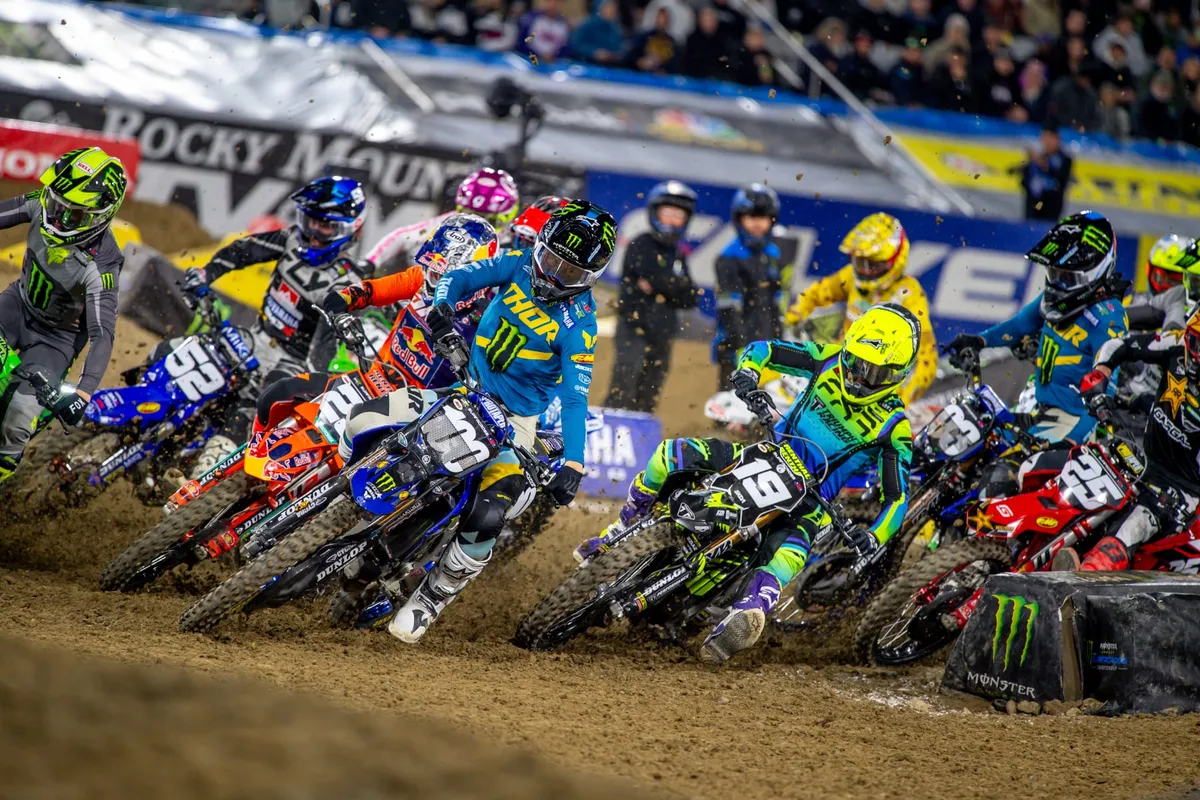
The 2027 Monster Energy AMA Supercross Championship is introducing some of its biggest rule changes in recent years, with smaller Main Event starting fields, an increased minimum age for professional competitors, mandatory chest and back protection and stricter motorcycle noise limits.
However, it is the revised race format that could have the biggest influence on the championship. The number of riders progressing into the evening programme will fall from 40 to 38, heat races will become smaller and only 20 competitors will line up for each Main Event instead of 22.
The AMA has also adjusted the championship points system to reflect the smaller starting field. Although the points awarded to the top four finishers remain unchanged, riders finishing fifth through to 20th will receive one fewer point than under the 2026 system.
Some of these developments are designed to improve rider safety, while others address the practical challenges of running professional Supercross inside stadiums. Here's a breakdown of what is changing, why the rules have been introduced and what they could mean for the 2027 season.
1. Main Events reduced from 22 riders to 20
The biggest change for 2027 is the reduction in Main Event grid size. Instead of allowing 22 riders to compete in each race, the AMA will now limit the field to 20.
The decision is intended to reduce congestion on the track, particularly when faster riders begin catching the backmarkers. Lapped traffic has become an ongoing talking point in Supercross, with riders having to negotiate competitors who are significantly slower while fighting for positions at the front.
Removing two riders from each Main Event should create a little more space around the circuit, potentially reducing the number of dangerous interactions between leading riders and those being lapped.
The smaller field is also expected to reduce track deterioration, although the amount of improvement will depend on the individual circuit, its construction and the conditions on race night.
Our analysis: I think this could be one of the more meaningful changes for the quality of racing. Supercross tracks are already tight, and when riders begin encountering lapped competitors, it can completely change the outcome of a race. Two fewer bikes may not solve every traffic problem, but it should give the leaders more room to concentrate on their own races.
It could also make the final laps more interesting. With fewer competitors on the track, riders fighting for the final podium positions may have a clearer route to the finish without constantly negotiating slower traffic.
2. Only 38 riders will qualify for the night programme
To accommodate the new 20-rider Main Event format, the AMA is changing how many competitors progress from qualifying into the evening programme.
Previously, the 40 fastest riders would qualify for the night show. In 2027, that number becomes 38, creating what has effectively become the Fast 38 instead of the familiar Fast 40.
The maximum number of entries per class will also be reduced from 80 to 66. This allows organisers to divide competitors into three qualifying groups, each containing a maximum of 22 riders.
Although the lower entry limit might initially appear to be a major restriction, the reported intention is to organise qualifying more efficiently rather than dramatically reduce the number of competitors. Entries rarely approached the previous maximum at many events.
3. Heat races become more important
The revised qualifying system also changes the numbers progressing from the heat races.
Under the previous format, the fastest 40 riders reached the evening programme and competed in two heats of 20. The top nine from each heat transferred directly into the Main Event, with four additional riders advancing through the Last Chance Qualifier.
For 2027, the system will work as follows:
- Maximum entries: 66 riders per class.
- Qualifying: Three groups of up to 22 riders.
- Night programme: The fastest 38 riders.
- Heat races: Two races featuring 19 riders each.
- Direct transfers: The top eight from each heat.
- Last Chance Qualifier: Four additional riders transfer.
- Main Event: 20 riders on the starting gate.
The mathematics behind the change is important. With 38 riders entering the heat races, 16 will transfer directly to the Main Event, leaving 22 competitors for the LCQ. Four of those riders will then secure the remaining positions on the 20-rider starting gate.
If the night programme continued to include 40 riders, the new eight-rider heat transfer would leave 24 competitors in the LCQ, exceeding the 22 available starting positions. Reducing the Fast 40 to 38 solves that problem.
What does this mean for the racing? Finishing ninth in a heat race will become considerably more costly. Under the old rules, ninth place was enough for an automatic Main Event transfer. Now, only the first eight qualify directly, meaning riders on the edge of those positions will have to fight their way through the LCQ.
I expect qualifying and the heat races to become even more important. A poor qualifying session could put a rider into a difficult position before the racing has properly begun, while avoiding the LCQ will become an increasingly important part of a successful race night.
4. New AMA Supercross points system for 2027
With two riders removed from the Main Event, the championship points system has also been adjusted.
The winner will continue to receive 25 points, second place earns 22 and third receives 20. Fourth place remains worth 18 points, but from fifth position onwards the points allocation has been reduced by one compared with 2026.
The changes mean that 20th place will now be the final points-paying position, worth one championship point. Previously, 21st place earned one point, while 22nd received none.
2026 versus 2027 AMA Supercross points
| Finish position | 2026 points | 2027 points |
|---|---|---|
| 1st | 25 | 25 |
| 2nd | 22 | 22 |
| 3rd | 20 | 20 |
| 4th | 18 | 18 |
| 5th | 17 | 16 |
| 6th | 16 | 15 |
| 7th | 15 | 14 |
| 8th | 14 | 13 |
| 9th | 13 | 12 |
| 10th | 12 | 11 |
| 11th | 11 | 10 |
| 12th | 10 | 9 |
| 13th | 9 | 8 |
| 14th | 8 | 7 |
| 15th | 7 | 6 |
| 16th | 6 | 5 |
| 17th | 5 | 4 |
| 18th | 4 | 3 |
| 19th | 3 | 2 |
| 20th | 2 | 1 |
| 21st | 1 | Not applicable |
| 22nd | 0 | Not applicable |
The most interesting part of this change is that the winner, runner-up, third and fourth-place finishers continue to receive exactly the same points as before.
It is the riders further down the order who will feel the difference. A fifth-place finish now earns one fewer point, and the same reduction applies all the way through to 20th.
Our analysis: I don't think this will dramatically change how the leading championship contenders approach a race. The biggest rewards remain with the top four, so winning and consistently finishing on the podium will still be the priority.
However, riders outside the top positions will have slightly less reward for recovering from a difficult race. Over a long championship, losing one point at several rounds could become significant, particularly for riders fighting for positions just outside the leading group.
5. Minimum age for professional Supercross increases to 18
Another important change concerns the minimum age required to obtain an AMA professional rider licence.
From 2027, competitors must be at least 18 years old to qualify for an AMA Rider Licence for the professional Supercross classes. Previously, the minimum age was 17.
The reason behind the decision is largely connected to insurance. Providing coverage for under-18 competitors at professional events can create additional difficulties and costs for promoters. Raising the age requirement is intended to make the insurance arrangements surrounding professional racing easier to manage.
This does not mean that younger riders will disappear from Supercross events. Development programmes such as SMX Next operate separately from the professional classes, providing opportunities for younger competitors to gain experience and progress towards professional racing.
Our take: The change could delay the professional arrival of some exceptionally talented young riders, but it also reinforces the importance of development categories. The pathway towards professional Supercross will remain available, although riders will need to meet the new age requirement before entering the premier professional classes.
6. Chest and back protection becomes compulsory
Safety equipment is receiving greater attention in the 2027 rulebook, with chest and back protection now mandatory for all competitors.
Previously, the decision to wear this equipment was left to the individual rider. From 2027, every competitor must wear an appropriate protector covering the chest and back areas.
The protection can be worn underneath or over the rider's jersey, provided it meets the requirements set out in the regulations. The rulebook specifies coverage of the sternum, ribs and spine.
This is a straightforward safety improvement. Supercross involves large jumps, close racing and frequent contact, so additional protection around the upper body is a sensible requirement.
It may require some riders to change their existing equipment or adjust their riding kit, but the priority is ensuring that all competitors meet the same minimum protection standard.
7. Supercross motorcycles must meet a lower sound limit
Another significant development is the reduction in the permitted motorcycle noise level.
For 2027, the maximum sound limit will be 109 dB/A during pre-race inspection and 110 dB/A during post-race inspection. Previous reporting on the change describes the pre-race limit as falling from 112 dB/A to 109 dB/A.
Interestingly, the move towards quieter motorcycles has reportedly been driven in part by the manufacturers themselves, rather than being solely imposed by stadium operators or the championship promoter.
Noise restrictions have become an increasingly important issue for motocross and off-road riding venues, particularly in Europe, where some facilities face restrictions or closure following complaints from nearby communities.
The manufacturers have therefore recognised that quieter production motorcycles can help protect the future of the sport. The tighter standard has been introduced once production bikes were considered capable of meeting it.
There is also an important consideration for privateer riders. Manufacturer support is expected to be made available at race meetings to help smaller teams meet the new sound requirements, rather than leaving them to deal with the changes entirely on their own.
Our analysis: This is an important long-term development. Supercross and motocross need access to venues, and noise complaints can make that increasingly difficult. Quieter motorcycles could help protect the relationship between racing and the communities surrounding these facilities.
For privateers, the key will be ensuring that compliant exhaust systems and technical support are accessible without creating another expensive obstacle to professional competition.
8. Triple Crown events receive their own qualifying changes
The 2027 rule changes also affect the Triple Crown format, where riders compete in three separate Main Events rather than one conventional race.
For Triple Crown events, the fastest 16 riders in qualifying will advance directly to the three races. Competitors qualifying between 17th and 38th will then compete in an LCQ, with the top four earning the remaining starting positions.
There is also a change concerning spare machinery. Riders will no longer be permitted to use a second motorcycle during Triple Crown events.
This means teams will need to prepare their primary race bike carefully, as a mechanical issue could have a much greater impact when riders are competing in three races on the same evening.
It also places additional importance on qualifying. Finishing inside the top 16 avoids the LCQ altogether, allowing riders to concentrate on preparing for the three races rather than fighting for a starting position.
From a fan's perspective, the Triple Crown format could become even more unpredictable. Smaller fields and the pressure of qualifying through an LCQ may create a different dynamic before the three races even begin.
What do the 2027 rule changes mean for championship contenders?
Looking at the overall impact, the new regulations are likely to affect different groups of riders in different ways.
The leading factory riders will still be judged on their ability to win races and consistently finish on the podium. Because the points awarded to the top four remain unchanged, the biggest championship rewards have not been altered.
However, riders fighting for positions just outside the podium will have less opportunity to collect valuable points from difficult evenings. They will also need to be more careful during qualifying and heat races, where the reduction in direct transfer positions increases the importance of finishing inside the top eight.
Privateer teams may benefit from the manufacturers' reported willingness to help with sound compliance, but they will also need to prepare for the smaller entry and qualifying structure. The mandatory protection requirement is another equipment consideration for every competitor.
For younger riders, the increased minimum age changes the point at which they can enter professional competition. Development programmes will become even more important for those building towards a professional career.
Our verdict: will the 2027 Supercross rule changes improve racing?
The 2027 AMA Supercross rulebook introduces a combination of safety measures, technical requirements and racing-format changes. Some are relatively straightforward, such as mandatory chest and back protection, while others could have a noticeable effect on the way race nights unfold.
For me, the reduction to 20-rider Main Events is the most interesting change. Supercross tracks are demanding enough without adding unnecessary congestion, and reducing the number of competitors could create cleaner racing and fewer situations involving lapped riders.
The new heat-race format could also make qualifying more important. With only eight direct transfers available from each heat, riders will have less room for a poor start or an early mistake. A rider who previously finished ninth and secured an automatic Main Event position will now have to fight through the LCQ.
The revised points system is less dramatic than the grid-size change, but it reinforces the importance of consistent results. The leading four positions retain their existing points, while those further down the order receive slightly less reward.
The stricter sound limit is another positive development for the long-term future of motocross and Supercross, particularly if manufacturers make it easier for privateers to comply.
Ultimately, the first few rounds will tell us a lot about how successful these changes are. If racing becomes cleaner, lapped traffic is reduced and the qualifying programme remains competitive, the smaller Main Event format could prove to be one of the more worthwhile Supercross rule changes in recent years.
The 2027 season is set to begin at Anaheim 1 on 9 January, and it will be the first real test of how these new regulations influence the sport's biggest indoor championship.