
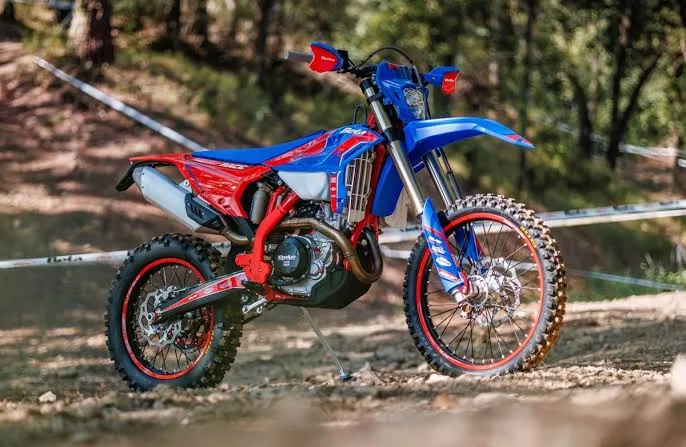
2027 Beta RR Race Enduro Range: Eight Bikes Get Smarter, Stronger and More Refined
Beta has updated its RR Race enduro range for 2027, bringing new electronics, engine revisions, suspension changes and durability improvements to all eight race-focused models. But are these really upgrades that matter on the trail, or is Beta simply polishing an already competitive package?
Beta's 2027 RR Race range is not an all-new generation of enduro motorcycles. Instead, the Italian manufacturer has concentrated on improving areas that can make a genuine difference to performance: engine response, electronic control, suspension behaviour, electrical reliability and the durability of components that take a beating during competition.
The result is a familiar eight-bike line-up consisting of four two-strokes and four four-strokes:
- RR Race 125 2T
- RR Race 200 2T
- RR Race 250 2T
- RR Race 300 2T
- RR Race 350 4T
- RR Race 390 4T
- RR Race 430 4T
- RR Race 480 4T
Beta positions the RR Race at the performance end of its enduro family, above the more versatile RR X-PRO range. The philosophy is straightforward: take Beta's competition technology and put it into motorcycles that are ready to be pushed hard from the moment they leave the dealer.
For 2027, however, Beta has taken an interesting approach. Rather than chasing headline-grabbing horsepower figures, the company has concentrated on making the bikes more controllable, more consistent and better equipped to deal with the punishment of racing.
The 2027 Beta RR Race Range at a Glance
| Model | Engine | Key 2027 Changes |
|---|---|---|
| RR Race 125 | 2-stroke | Revised piston for smoother power delivery |
| RR Race 200 | 2-stroke | Shared chassis, suspension and durability updates |
| RR Race 250 | 2-stroke | New main bearings to reduce internal friction |
| RR Race 300 | 2-stroke | New main bearings, revised cylinder head and exhaust valve timing |
| RR Race 350 | 4-stroke | Launch control, quick shift, electrical and chassis updates |
| RR Race 390 | 4-stroke | Launch control, quick shift, electrical and chassis updates |
| RR Race 430 | 4-stroke | New titanium intake valves and revised cam-chain tensioner |
| RR Race 480 | 4-stroke | New titanium intake valves and revised cam-chain tensioner |
Four-Strokes Finally Get the Electronic Upgrade
The biggest headline for the four-stroke RR Race models is the arrival of five-level launch control and up-only quick shift.
These systems have already appeared on Beta's newer X-PRO models, and they now make their way onto the race-focused four-strokes.
They join the existing two-level traction control and selectable engine maps designed for different riding conditions.
All of these functions are controlled through redesigned handlebar switchgear incorporated into the handguard area.
On paper, this makes the RR Race four-strokes considerably more sophisticated than before.
But there is an important distinction here.
For professional riders: a genuine performance advantage
For a professional or serious championship rider, the new electronics could be very useful.
Launch control isn't something most trail riders desperately need. At the start of a special test, however, getting the rear wheel to hook up cleanly rather than spinning away horsepower can make a measurable difference.
The five levels also give the rider more scope to tailor the launch behaviour to the conditions.
Meanwhile, an up-only quick shifter has the potential to reduce the interruption to acceleration when changing gear at high engine speed.
That is exactly the sort of technology that makes more sense the faster and harder the motorcycle is being ridden.
For beginners: useful, but definitely not essential
For a novice, I am less convinced that these features will transform the riding experience.
A beginner is unlikely to extract the same benefit from launch control as an experienced racer, and there is an argument that having more buttons and settings can actually make a motorcycle feel more complicated.
That said, the electronics are there when the rider improves.
A novice buying an RR Race is buying a competition-oriented motorcycle with considerably more performance than they are initially going to use. The new electronic package gives them another layer of adjustment as their ability develops.
My verdict: a clear positive, but much more important for racers than recreational riders.
Beta Has Also Worked on Electrical Reliability
The four-strokes receive another less glamorous but potentially more valuable change in the form of an upgraded voltage regulator.
Beta says the new system provides a higher and more stable voltage to the battery, with the aim of improving electrical reliability and increasing charging capacity.
This isn't the sort of upgrade that will make a bike look faster in a showroom photograph.
But in real enduro competition, reliability matters enormously.
An electrical system that consistently maintains the battery's charge is much more valuable than another small increase in peak performance if it prevents an avoidable problem during a race.
This is one of the 2027 changes I actually like the most because it targets reliability rather than marketing numbers.
Big Changes for the RR Race 430 and 480
The two largest four-stroke engines receive some additional internal revisions.
Both the RR Race 430 and RR Race 480 receive newly finished titanium intake valves.
Beta has also introduced a new cam-chain tensioner derived from its RX 450 F motocross motorcycle.
The new tensioner moves away from the previous mechanical-hydraulic arrangement to a purely mechanical system using a newly calibrated spring.
Again, this isn't necessarily about making the biggest engines dramatically more powerful.
It is about refining the engine package and improving consistency in an area where reliability is particularly important.
The 480 is already positioned by Beta as the most powerful motorcycle in the RR Race family, aimed squarely at experienced riders who can exploit its substantial torque and speed.
That means I would rather see Beta spending development time on durability and control than simply chasing another few horsepower.
The Two-Strokes Get a Different Kind of Upgrade
The two-stroke models don't receive the same electronic expansion as the four-strokes.
Instead, Beta has concentrated on refining the engines themselves.
RR Race 125
The smallest RR Race gets an updated piston intended to smooth out its overall power delivery.
That sounds like a relatively minor change, but on a 125 two-stroke, power delivery matters enormously.
A high-revving 125 can be exciting when ridden aggressively, but smoother delivery should make the engine easier to control when traction is limited or the rider is trying to maintain momentum through technical terrain.
For younger or less experienced riders, that could actually be more beneficial than simply increasing outright power.
RR Race 250 and 300
Both the 250 and 300 two-strokes receive new main bearings designed to reduce internal friction.
The 300 gets the more substantial engine work.
Beta has revised the cylinder-head geometry and exhaust-valve timing with the specific objective of producing a more progressive response through the low and mid-range.
That is an interesting direction for the RR Race 300.
The 300 two-stroke already has more than enough performance for virtually any enduro rider. The challenge isn't necessarily making it more aggressive. The challenge is making that performance easier to use.
For hard enduro, that could be particularly important.
A smoother response when the throttle is opened at low and medium rpm can help the rear tyre find traction rather than immediately breaking loose.
In my view, this is one of the smartest changes Beta could have made to the 300.
More power isn't necessarily what a modern enduro bike needs. Better power can be much more useful.
The Chassis and Suspension Have Been Refined Too
The engine changes might grab the headlines, but the suspension revisions could be just as important once the wheels start turning.
Beta has revised the settings of the KYB sealed-cartridge front fork and C46 RCU rear shock, using input from its engineers and race team.
The hardware remains fundamentally familiar, but the internal valve settings have been recalibrated.
This is a sensible approach.
The RR Race is already equipped with serious competition suspension, so replacing perfectly good hardware simply for the sake of having something new would make little sense.
Getting the valving and settings right can have a much bigger effect on how a bike actually feels.
For a professional rider, this should provide another starting point for suspension tuning.
For an amateur rider, the result could be more difficult to quantify because suspension setup is highly dependent on rider weight, ability, terrain and riding style.
But a well-developed base setting is always preferable to a poorly developed one.
Beta Hasn't Forgotten the Parts That Get Destroyed
One of the less exciting but more welcome changes for 2027 is the reinforced chain guide.
Enduro is brutal on chain guides. Rocks, mud, ruts and logs can turn what looks like a small plastic component into a surprisingly important failure point.
Beta has strengthened the structure while also aiming to reduce the likelihood of the chain derailing.
The output sprocket guard has also been redesigned with wider coverage and increased strength.
These aren't glamorous upgrades, but they are exactly the sort of changes that can matter when a race bike is being used in the conditions it was designed for.
The softer compound grips should also be a welcome change for riders spending long hours on the bike.
They won't make the motorcycle faster, but reducing vibration and hand fatigue can make a difference during a long enduro day.
A New LED Headlight and Larger Trailtech Dashboard
The front end has also been updated with a new mask incorporating Beta's latest-generation LED headlight.
The design first appeared elsewhere in Beta's range and now reaches the RR Race models.
There is also a new, larger Trailtech dashboard.
The information displayed is broadly familiar, but the larger unit should be easier to read while riding. Beta has also paired it with a new wheel-speed pickup lead.
Again, this is more evolution than revolution.
But I would rather have a larger and more durable display on an enduro bike than a complicated colour screen packed with information that is difficult to read when you're bouncing through a special test.
So, Is the 2027 RR Race Actually Better?
Yes, but the improvements are more about refinement than transformation.
That distinction is important.
If you already own a relatively recent RR Race, there isn't enough here to make me think you need to sell your current motorcycle immediately.
But if you are buying a new competition-focused Beta, the collection of updates makes the 2027 bikes a more complete package.
The four-strokes gain useful electronic technology, improved electrical management and internal engine revisions on the larger models.
The two-strokes get engine refinement, particularly the 300, where smoother low- and mid-range response could be more useful than another increase in peak performance.
Across the entire range, the suspension, controls, protection and durability details have also been improved.
What Do the Changes Mean for Professional Riders?
For a professional racer, I think the 2027 RR Race updates make considerable sense.
Professional riders are operating much closer to the limits of the motorcycle. Small improvements in traction, shifting, suspension behaviour and engine response can become meaningful when repeated hundreds of times throughout a race season.
The new launch control and quickshifter are particularly relevant to this group.
So are the revised suspension settings.
And perhaps most importantly, Beta has continued developing the motorcycle without moving away from the fundamental RR Race concept.
That matters because professional riders don't necessarily want a bike that feels completely different every year. They want a platform they understand, with the weak points gradually removed.
For racing, the 2027 RR Race looks like a case of making a good competition bike easier to exploit rather than trying to reinvent it.
What About Novice Riders?
This is where things become more complicated.
Beta itself separates the roles of its enduro families, with the XTrainer aimed at riders getting into enduro and the RR X-PRO positioned as a more versatile option, while the RR Race is explicitly the competition-focused choice.
That makes the RR Race an unusual choice for a complete beginner.
The 2027 improvements don't change that.
In fact, the additional performance and electronic features could make the Race feel like more motorcycle than a novice actually needs.
However, an experienced trail rider who is moving into competition is a different story.
For that rider, the Race makes much more sense. The suspension, engine character and competition equipment provide a platform that can grow with the rider.
If you're learning to ride enduro from scratch, I'd be looking at the more forgiving models in Beta's range first.
If you're already comfortable off-road and want to start racing, the RR Race becomes much more attractive.
Which 2027 RR Race Would I Choose?
If I were choosing purely around versatility, the RR Race 300 2T would immediately attract my attention.
The 300 has enough torque and power for serious enduro, while Beta's decision to make the low- and mid-range response more progressive could make the 2027 version particularly interesting for technical riding.
For riders who prefer four-strokes, the 350 4T is arguably the most accessible starting point within the four-stroke Race family.
At the other end, the 480 4T is very clearly an experienced-rider machine. Beta itself describes it as a motorcycle requiring technique and determination, despite the electronic systems and chassis designed to help manage its performance.
The 125 and 200 two-strokes also remain interesting propositions for riders who want a lighter, more rev-focused style of enduro, although the ideal choice will ultimately depend heavily on rider size, experience and the type of terrain being ridden.
My Take on the 2027 Beta RR Race Range
I think Beta has made the right decision with the 2027 RR Race.
There is nothing particularly revolutionary here, and that's actually a good thing.
The RR Race is already a competition-focused motorcycle, so Beta didn't need to completely redesign it. Instead, the company has identified areas where racers actually benefit from development and worked on those areas.
The new electronics make the four-strokes more competitive.
The 430 and 480 engine revisions should improve the overall package.
The 300 two-stroke's revised power characteristics could be particularly interesting for technical enduro.
The suspension revisions should give racers a better platform to work from.
And the reinforced chain guide, stronger sprocket protection, improved electrical system and larger dashboard are the sort of practical changes that can make a motorcycle easier to live with over an entire season.
What I don't think Beta has done is make the RR Race suddenly become a better choice for a complete novice.
That isn't really its job.
The RR Race is supposed to be the sharp end of Beta's enduro range, and the 2027 updates reinforce that position rather than soften it.
Verdict: Evolution Rather Than Revolution
The 2027 Beta RR Race range looks like a carefully considered update rather than a marketing exercise.
There are no huge headline changes, but there are plenty of smaller improvements that collectively make sense.
For professional and serious amateur racers, the new electronics, suspension development and engine refinements should make an already capable race platform more usable and more adaptable.
For recreational riders, some of those features will be less important. In fact, if you're mainly trail riding rather than competing, the RR X-PRO may make more sense because Beta positions that range around versatility and comfort rather than outright race performance.
But for riders who genuinely want a Beta built around racing, the RR Race remains the bike at the sharp end of the range.
And the most interesting update of all might ultimately be the one that isn't immediately obvious: Beta appears to be concentrating on making the existing performance easier to use, rather than simply making the motorcycles more powerful.
In modern enduro, that's exactly the direction I'd want to see.
2027 Beta RR Race Models
| Model | Engine | Best Suited To |
|---|---|---|
| RR Race 125 2T | 125cc two-stroke | Lightweight, high-rev riding and developing riders |
| RR Race 200 2T | 200cc two-stroke | Lightweight competition and technical enduro |
| RR Race 250 2T | 250cc two-stroke | Experienced riders wanting a versatile race bike |
| RR Race 300 2T | 300cc two-stroke | Serious enduro and technical terrain |
| RR Race 350 4T | 350cc four-stroke | Riders wanting four-stroke performance with manageable character |
| RR Race 390 4T | 390cc four-stroke | Experienced racers wanting additional torque |
| RR Race 430 4T | 430cc four-stroke | Fast enduro and serious competition |
| RR Race 480 4T | 480cc four-stroke | Experienced riders and high-speed competition |
When Will the 2027 Beta RR Race Arrive?
Beta says the 2027 RR Race models are expected to begin arriving at dealers worldwide from October 2026. Pricing for the new range has not yet been confirmed.
That means UK buyers will have to wait for local dealer pricing before deciding how attractive the 2027 models are compared with discounted outgoing bikes.
And that could be important.
With the 2027 bikes representing an evolution rather than a complete redesign, a heavily discounted previous-generation RR Race could potentially become a very tempting alternative for riders who don't need the latest electronics and engine refinements.
Final Thoughts
The 2027 Beta RR Race range doesn't attempt to reinvent Beta's competition enduro formula.
Instead, it takes eight already serious motorcycles and concentrates on the details: better control, smoother engine response, improved suspension settings, stronger components and more sophisticated electronics.
For a professional rider, those details can add up to a significant advantage.
For a novice, they are less important — and the RR Race remains a bike that makes more sense once you already have a solid foundation of off-road riding experience.
Beta hasn't made the RR Race softer. It has made it more refined.
And for a race bike, that could be the more important upgrade.
Source: Beta Motor official 2027 RR Race range information and model information.