
2027 Husqvarna Motocross Range, What's Better and Who Really Benefits?
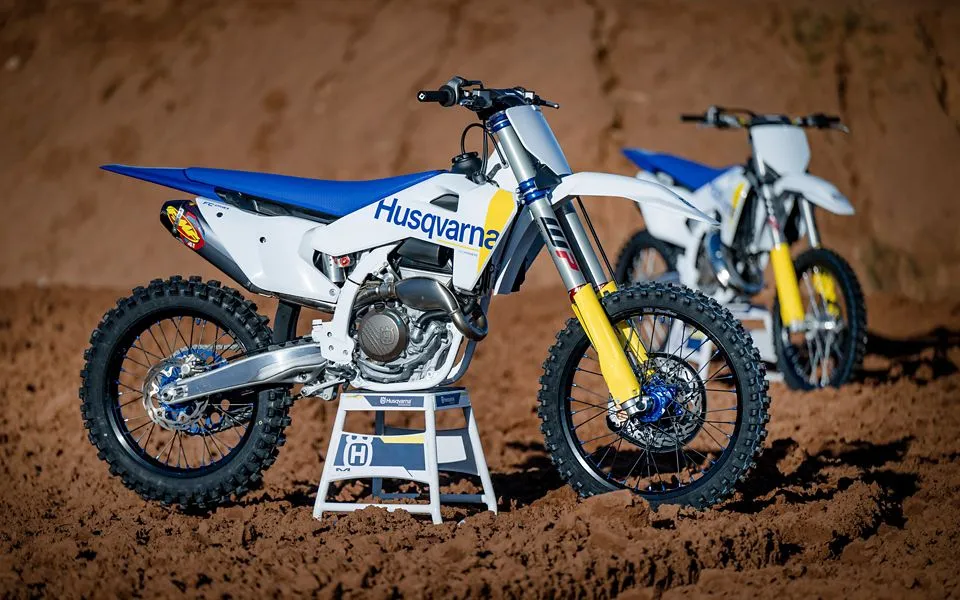
Husqvarna has rolled out its 2027 adult motocross range with six machines covering everything from the high-revving TC 125 two-stroke to the flagship FC 450 four-stroke. But beneath the familiar white bodywork is a much more interesting story: Husqvarna is continuing to refine chassis flex, mass centralisation, suspension performance, electronic control and two-stroke technology in an attempt to make its race bikes both faster and easier to exploit.
The 2027 adult Husqvarna motocross line-up consists of three two-strokes — the TC 125, TC 250 and TC 300 — and three four-strokes — the FC 250, FC 350 and FC 450. Husqvarna positions the range around high-performance motocross, with the six bikes sharing a common competition-focused chassis philosophy while using very different engine characteristics.
At first glance, this might look like another annual model-year update.
It isn't.
The interesting thing about the 2027 Husqvarna range is that the manufacturer is not simply chasing bigger power figures. Instead, much of the development is concentrated on how the motorcycle manages its performance.
That includes frame rigidity and flex, engine mass centralisation, suspension behaviour, rider ergonomics, electronic engine management and the increasingly sophisticated two-stroke package.
And that raises a much more useful question than simply asking whether the 2027 bikes are "faster".
Are they actually better motorcycles for the people who will buy them?
The 2027 Husqvarna Adult Motocross Range
| Model | Engine | My Take |
|---|---|---|
| TC 125 | 125cc 2-stroke | The technique builder |
| TC 250 | 250cc 2-stroke | The traditional race two-stroke |
| TC 300 | 300cc 2-stroke | The wildcard |
| FC 250 | 250cc 4-stroke | The precision tool |
| FC 350 | 350cc 4-stroke | The all-round sweet spot |
| FC 450 | 450cc 4-stroke | The professional weapon |
That spread is important because Husqvarna doesn't need every bike to appeal to exactly the same rider.
The TC 125 is about momentum and technique. The TC 250 delivers the classic two-stroke race experience. The TC 300 adds another level of torque and acceleration.
On the four-stroke side, the FC 250 rewards carrying speed, the FC 350 offers a compromise between the 250 and 450, while the FC 450 remains the outright heavyweight.
The Biggest Story Is the Chassis
If there is one area that defines the modern Husqvarna motocross range, it is the chassis.
The 2027 motorcycles continue to use a chromium-molybdenum steel frame with carefully controlled rigidity and flex characteristics. Husqvarna says the frame uses optimised wall thickness in high-stress areas, with the objective of delivering feedback, energy absorption and straight-line stability.
The FC 450 also uses a frame with optimised material distribution around the steering head and upper shock mount, with Husqvarna specifically targeting stability when entering corners.
This might sound like factory-racing language that only matters to professional riders.
It doesn't.
Chassis behaviour is something every motocross rider experiences.
The difference is that a professional can actually identify what the motorcycle is doing and make suspension, tyre and setup changes around it.
An average rider is more likely to describe the same characteristic as:
- "It feels planted."
- "It doesn't move around as much."
- "It turns better."
- "It gives me more confidence."
That is why chassis development matters.
The rider doesn't need to understand the engineering to benefit from it.
But There's a Catch With a Race-Bred Chassis
This is one area where I think buyers need to be realistic.
A frame developed around professional motocross is not automatically perfect for every rider.
A 65kg professional rider, an 85kg expert and a 100kg weekend rider can place completely different demands on the suspension and chassis.
That means the 2027 Husqvarna's underlying hardware can be extremely capable while still requiring setup work before an individual rider gets the best from it.
The better the motorcycle becomes, the more important correct setup becomes.
That is particularly true of the suspension.
WP XACT Suspension Remains a Major Part of the Package
The adult Husqvarna motocross models continue with sophisticated WP XACT suspension.
The FC 450 uses 48mm WP XACT closed-cartridge spring forks, with mid-valve damping and a hydrostop working through the final part of the suspension travel to help control hard landings. The rear shock provides adjustable rebound and high- and low-speed compression settings.
The two-stroke TC 300 uses 48mm WP XACT forks with an adjustable air spring and pressurised oil chamber, again using a mid-valve damping system and hydrostop.
That gives Husqvarna a very serious suspension package across the adult range.
For the professional
This is a major advantage.
A professional rider can use the available adjustment range to build the bike around their exact requirements, track conditions and riding style.
Hard-packed tracks, deep sand and rough outdoor circuits can demand very different settings.
For the everyday rider
This is where things become more complicated.
Having lots of adjustment is brilliant if you know what you're doing.
If you don't, it is possible to spend an afternoon clicking away at the suspension and end up with a motorcycle that feels worse than when you started.
For a club rider buying a 2027 Husqvarna, I would put professional suspension setup surprisingly high on the list of things worth spending money on.
It could make a bigger difference to your riding than many of the headline engine features.
The Subframe Is Designed to Add Controlled Flex
Husqvarna continues to use a two-piece subframe made from a combination of polyamide and aluminium.
The manufacturer states that the construction is approximately 60% polyamide and 40% aluminium, with the upper section injection-moulded to provide specific flex characteristics while keeping weight low.
Again, this isn't about making the motorcycle look technologically impressive.
The objective is to control how the rear of the bike responds to the rider and terrain.
That can influence comfort, traction and stability.
For an expert rider attacking a rough track, that can be extremely important.
For an amateur, the benefit is more likely to appear as reduced fatigue and a bike that feels more predictable as the track deteriorates.
The Four-Strokes Concentrate on Mass Centralisation
The FC four-strokes continue Husqvarna's focus on centralising the engine and rotating mass.
The FC 450's 449.9cc engine weighs a claimed 26.8kg and is positioned to centralise mass and improve chassis behaviour, including anti-squat characteristics.
The engine uses a compact SOHC cylinder head, lightweight piston and carefully positioned crankshaft, with Husqvarna targeting a combination of performance, traction and rideability.
These are not changes that necessarily show up as a bigger number on a dyno sheet.
They are about making the motorcycle's weight work for the rider rather than against them.
FC 450: The Bike for Riders Who Can Actually Use It
The FC 450 remains the flagship four-stroke in Husqvarna's motocross range.
Husqvarna describes it as the top-performing machine in the line-up, combining its chassis technology with a high-output engine and a full suite of electronic rider aids.
The electronics include two engine maps, traction control, launch control and Quickshifter. Map 1 is designed around a more linear response, while Map 2 gives a sharper and more aggressive character.
For a professional rider
The FC 450 makes perfect sense.
At professional level, the rider has the strength, technique and race speed required to exploit the engine.
They can use the electronics as another layer of tuning and adapt the bike to track conditions.
The 450's huge performance is not simply about top speed. It gives a rider the ability to clear jumps, accelerate out of deep ruts and recover momentum when the track becomes rough.
For the average rider
I'm much less convinced that the 450 is the best choice.
It is an incredible motorcycle.
That doesn't mean it is the right motorcycle for you.
A less experienced rider can easily find themselves using only a fraction of the engine's potential while carrying the additional physical and mental workload of controlling a 450.
For a fast expert, the FC 450 is a weapon. For an average weekend rider, the FC 350 is arguably the smarter buy.
FC 350: Probably the Husqvarna Sweet Spot
The FC 350 is arguably the most interesting motorcycle in the four-stroke range.
It occupies the space between the 250 and 450 without simply being a compromise between the two.
The engine has enough capacity to provide substantial torque, but the motorcycle retains the high-revving character that makes a 250 four-stroke appealing.
For an experienced club racer, that combination can be extremely attractive.
You can ride it aggressively without having to physically manage a 450 all day.
For a professional, the 350 also makes sense where regulations and class structures allow it.
This is the bike I think could appeal to the largest group of genuinely serious adult riders.
Not beginners.
Not necessarily factory-level racers.
But the experienced riders sitting between those two groups.
FC 250: The Technique Bike
The FC 250 remains a fascinating proposition because it rewards rider technique rather than simply giving the rider more torque.
A 250 four-stroke asks the rider to carry momentum.
You have to maintain corner speed.
You need to select the correct gear.
You have to use the engine's rev range properly.
That can make the bike more demanding than a 450 in some situations, but it can also make the rider better.
For an expert racer, that high-revving nature can become a weapon.
For a developing rider, it is an education.
I would argue that the FC 250 makes more sense for someone who wants to improve their riding than someone who simply wants the easiest motorcycle to ride.
The Two-Strokes Are Where Husqvarna Gets Really Interesting
Husqvarna's two-stroke range consists of the TC 125, TC 250 and TC 300.
All three represent a modern interpretation of the two-stroke motocross motorcycle.
That means electronic fuel injection, electric starting and sophisticated electronic engine management rather than the carburettor-and-kick starter simplicity associated with older two-strokes.
Some riders will see that as progress.
Others will see it as removing part of what made two-strokes special.
I think both arguments have merit.
TC 125: Still One of the Best Ways to Learn Motocross
The TC 125 is the smallest adult Husqvarna motocross bike, but that doesn't mean it is the least interesting.
In fact, it could be one of the most valuable motorcycles for a developing racer.
A 125 forces the rider to maintain momentum.
You can't rely on a mountain of low-end torque to cover mistakes.
You need to carry speed into corners, keep the engine in the powerband and use the gearbox properly.
That teaches fundamental motocross skills.
For a professional rider, the same characteristics make the TC 125 useful as a training tool.
For a recreational rider, it can be enormously entertaining.
The downside is that riders who are used to larger engines may find it tiring because you have to work the bike hard.
My verdict: excellent for developing riders, experienced two-stroke fans and anyone who values riding technique over outright engine size.
TC 250: The Traditional Race Two-Stroke Goes High-Tech
The TC 250 is probably the most traditional-looking motorcycle in the range from a riding perspective.
It gives you the lightweight feel and aggressive power delivery that people expect from a 250 two-stroke.
But underneath that character is a modern electronic package.
That creates an interesting contradiction.
The bike feels old-school in spirit but modern in engineering.
For an expert rider, that combination is extremely attractive.
You get the immediacy of a two-stroke without necessarily accepting all of the traditional compromises.
For an everyday rider, the 250 can be more demanding than the FC 250 four-stroke.
You have to understand the power delivery and keep the engine working.
But for riders who enjoy that interaction, that is precisely the appeal.
TC 300: The Most Interesting Bike in the Range?
Husqvarna calls the TC 300 the ultimate two-stroke in its motocross line-up, and there is a good reason for the attention.
The fuel-injected 300cc engine combines strong peak power with usable torque, while an electronic exhaust control system manages the power delivery throughout the rev range.
The engine also uses a counter-balancer shaft designed to reduce vibration, while the crankshaft has been developed to keep rotating mass under control.
This is a very different two-stroke from the 300s of previous generations.
It isn't simply a big-bore engine thrown into a motocross chassis.
The electronics are being used to make the additional capacity usable.
Why experts will love it
An experienced rider can exploit the extra torque without necessarily having to rev the engine constantly.
That can be particularly useful on rough tracks where maintaining momentum becomes difficult.
The 300 also has the potential to make starts and deep-track sections very interesting.
Why beginners should think twice
More torque does not automatically mean easier riding.
A rider who is still learning throttle control can find a powerful 300 two-stroke more difficult to manage than a 125 or 250.
It can spin the rear wheel, lift the front and punish mistakes more quickly.
The TC 300 is a brilliant motorcycle. I just wouldn't recommend it simply because it is the biggest two-stroke.
Electronic Rider Aids: Helpful or Overkill?
The FC 450's electronic package gives riders access to two engine maps, traction control, launch control and Quickshifter.
The traction-control system monitors throttle input and engine-rpm acceleration, reducing rear-wheel power if it detects a loss of traction. Launch control similarly limits power during hard acceleration to improve rear-wheel grip.
For professionals, these are genuine tools.
For ordinary riders, they are more of a safety net and convenience feature.
There is nothing wrong with that.
But riders should not fall into the trap of thinking electronic aids can compensate for poor technique.
They can't.
A rider who learns to control wheelspin with their right hand is still going to be better prepared than someone who simply switches traction control on and expects the electronics to solve everything.
The technology should supplement rider skill, not replace it.
Quickshifter: Useful or Just a Gimmick?
Husqvarna's Quickshifter system can be activated from the handlebar switch and is designed to interrupt ignition momentarily during upshifts, allowing smoother clutchless gear changes. It is active from second gear upwards.
For racing, I think it is genuinely useful.
When you're accelerating hard with the throttle open, eliminating the need to close the throttle and use the clutch can make the shift process cleaner.
For a casual rider?
It is less important.
You can be extremely fast without it.
But that is the theme of the 2027 Husqvarna range: the technology isn't necessarily essential, but it gives an expert another tool.
The Two-Stroke Electronic Exhaust Control Is More Significant
The TC 300 uses an electronic exhaust control system instead of a conventional mechanically operated powervalve. Husqvarna says the system manages the opening of the lateral exhaust ports before the main exhaust ports to create strong but controllable power delivery.
That is one of the developments I find most interesting.
It suggests that the next stage of two-stroke development isn't simply about adding fuel injection.
It is about giving the ECU much more control over how the engine behaves.
That could eventually influence the entire two-stroke market.
If manufacturers can make large-capacity two-strokes deliver strong performance without becoming difficult to control, the category could become attractive to a much broader group of riders.
The Good: What Husqvarna Has Got Right
- Excellent chassis engineering: The focus on controlled flex, stability and rider feedback is exactly where modern motocross development should be heading.
- Strong suspension package: WP XACT hardware provides serious adjustment potential and race-level performance.
- Six-bike adult range: The 125 through 450 spread gives Husqvarna a strong selection without unnecessary duplication.
- Modern two-strokes: Fuel injection and electronic exhaust management show that Husqvarna is not abandoning two-stroke development.
- Excellent FC 350 concept: The 350 remains one of the most logical high-performance motorcycles for experienced amateurs.
- Mass centralisation: Engine positioning and lightweight internal components are being used to improve handling rather than simply chase peak horsepower.
- Serious electronics: The four-strokes provide useful rider aids without requiring an aftermarket electronics package.
- Adjustability: Expert riders have plenty of scope to tailor the bike to their preferences.
- Ergonomics: The chassis and bodywork are designed around rider movement rather than simply styling.
The Bad: Where I Think Husqvarna Could Lose Some Buyers
The bikes are becoming incredibly complicated
The modern Husqvarna is a long way removed from the basic motocross bikes many riders grew up with.
That's great for performance.
It isn't necessarily great for simplicity.
Electronic fuel injection, engine management, Quickshifter systems, traction control and electric starting all add technology to the motorcycle.
None of that automatically makes the bike unreliable, but it does mean there are more systems involved than on an old-school two-stroke.
The performance ceiling is much higher than most riders need
This isn't a Husqvarna-specific problem.
Modern motocross bikes are incredibly capable.
The problem is that an ordinary rider can spend thousands of pounds buying performance that they will never fully exploit.
For many club riders, suspension setup and rider fitness are going to make a bigger difference than the final few percent of engine performance.
The two-strokes aren't as mechanically simple as they once were
This could become a genuine dividing line in the market.
Some riders want a two-stroke precisely because it is simple.
Husqvarna is moving in the opposite direction.
Its two-strokes are becoming technologically sophisticated machines.
I think that is good for performance, but it won't appeal to everyone.
What Will the 2027 Husqvarnas Mean for the Everyday Rider?
This is probably the most important question.
If you're riding once or twice a month, you are unlikely to notice every engineering change Husqvarna has made.
You probably won't feel the difference between two subtly different frame flex characteristics.
You probably won't exploit the full adjustment range of the WP suspension.
And you certainly don't need the performance of a 450 to enjoy motocross.
But you will notice a motorcycle that feels stable, turns predictably, starts easily and has an engine you can control.
That's why I think the FC 350 and FC 250 are particularly interesting for ordinary experienced riders.
They provide enough performance to remain exciting without necessarily demanding the same level of physical input as the FC 450.
On the two-stroke side, the TC 125 is arguably the best choice for developing technique, while the TC 250 is the more traditional all-round race option.
What About the Pro and Expert Rider?
This is where the 2027 range really comes alive.
Professionals can exploit almost every aspect of the motorcycle.
They can tune the suspension.
They can adjust electronics.
They understand chassis feedback.
They can use the engine's entire rev range.
And they can turn small improvements in stability or traction into measurable lap-time gains.
For that rider, the 2027 Husqvarna isn't simply a motorcycle.
It is a platform that can be developed around the rider.
That's exactly what you want from a serious competition bike.
Which 2027 Husqvarna Would I Choose?
Best for a professional: FC 450
If you're racing at the highest level and have the physical ability and technique to exploit a 450, the FC 450 remains the obvious flagship.
Best for an experienced amateur: FC 350
This is my pick for the broadest range of serious adult riders.
It provides substantial performance without the same level of physical punishment associated with riding a 450 aggressively for a full race.
Best for developing racecraft: FC 250
The FC 250 rewards momentum, corner speed and precision.
If your priority is becoming a better rider rather than simply having the biggest engine, this is an excellent choice.
Best two-stroke for technique: TC 125
The 125 makes you work.
That is exactly why I like it.
Best traditional two-stroke: TC 250
If you want the classic two-stroke motocross experience but with modern technology underneath, the TC 250 is the logical choice.
Most interesting: TC 300
The TC 300 is the bike I would most want to test properly.
Its combination of 300cc capacity, fuel injection and electronic exhaust control makes it one of the most interesting modern two-strokes available.
Could Husqvarna Change the Motocross Market?
I think the biggest potential market impact comes from the two-strokes.
Husqvarna is demonstrating that a two-stroke doesn't have to remain trapped in the past.
It can have electronic fuel injection, electric starting, electronic power management and modern chassis engineering while retaining the lightweight character that attracts riders to two-strokes.
If this approach continues to work, it puts pressure on competitors.
The market could gradually split into two camps.
One group will continue to want mechanical simplicity.
The other will want the lightweight feel and response of a two-stroke combined with the convenience and control of modern electronics.
Husqvarna is clearly targeting the second group.
Husqvarna vs KTM: The Interesting Part
There is also an unavoidable comparison with KTM.
The two brands share much of their underlying technical architecture, so the question isn't necessarily which manufacturer has completely different engineering.
The more interesting question is which character riders prefer.
Husqvarna's positioning gives it an opportunity to appeal to riders who want the same level of competition technology but prefer the brand's styling, ergonomics and overall identity.
That means the battle between the two brands is becoming less about outright specification and more about how the motorcycle feels to the rider.
That is probably good for consumers.
If manufacturers are competing on chassis feel, ergonomics and rideability rather than simply horsepower numbers, riders ultimately get better motorcycles.
My Verdict on the 2027 Husqvarna Motocross Range
I think Husqvarna has taken the right direction with the 2027 adult motocross range.
The manufacturer isn't simply trying to make its motorcycles more powerful.
Instead, the focus is increasingly on making the available performance easier to control.
The chassis is designed around predictable flex and stability.
The engine is positioned around mass centralisation.
The suspension gives expert riders a huge amount of tuning potential.
The electronics provide additional control.
And the two-strokes demonstrate that Husqvarna is prepared to keep investing in a category that many manufacturers have effectively allowed to stagnate.
There are downsides.
The bikes are expensive, increasingly complicated and so capable that many ordinary riders won't come close to using everything they offer.
That's particularly important when choosing between the FC 450 and FC 350.
If you're a professional, the 450 makes sense.
If you're an experienced club racer, I'd seriously consider the 350.
If you're developing your technique, the 250 four-stroke or 125 two-stroke could ultimately make you a better rider.
And if you're a committed two-stroke fan, the TC 250 and TC 300 show just how far the category has evolved.
The Biggest Lesson From the 2027 Husqvarna Range
Perhaps the most important thing about the 2027 Husqvarna motocross bikes is that more technology doesn't necessarily mean the bikes are becoming less rider-focused.
In many ways, the opposite is happening.
Husqvarna is using technology to give the rider more control over how the motorcycle behaves.
The problem is that the more adjustment and performance you have, the more knowledge you need to get the best from it.
A professional rider sees that as an opportunity.
A novice might see it as unnecessary complexity.
That's why I wouldn't simply tell every rider to go out and buy the newest 2027 Husqvarna.
The best motorcycle is still the one that matches your ability, fitness, riding style and budget.
For the right rider, however, the 2027 Husqvarna range is an extremely sophisticated set of motocross machines — and the FC 350, FC 250 and TC 250 could be the bikes that make the most sense outside professional racing.
Final Thoughts
The 2027 Husqvarna adult motocross range is an evolution of an already highly developed platform, but there is plenty here to interest serious riders.
The FC 450 remains the professional weapon.
The FC 350 looks like the sweet spot for experienced amateurs.
The FC 250 remains one of the best choices for riders who want to develop speed and technique.
The TC 125 continues to reward momentum and commitment.
The TC 250 keeps the traditional two-stroke race experience alive.
And the TC 300 is arguably the most intriguing motorcycle in the entire range, showing how sophisticated the modern two-stroke has become.
Husqvarna isn't trying to make every rider faster simply by adding horsepower. It's trying to give riders a better platform for controlling the performance that is already available.
For a professional, that could mean lap time.
For an expert, it could mean confidence.
For an everyday rider, it could simply mean a motorcycle that is easier and more enjoyable to ride.
And ultimately, that is probably the most important upgrade of all.