
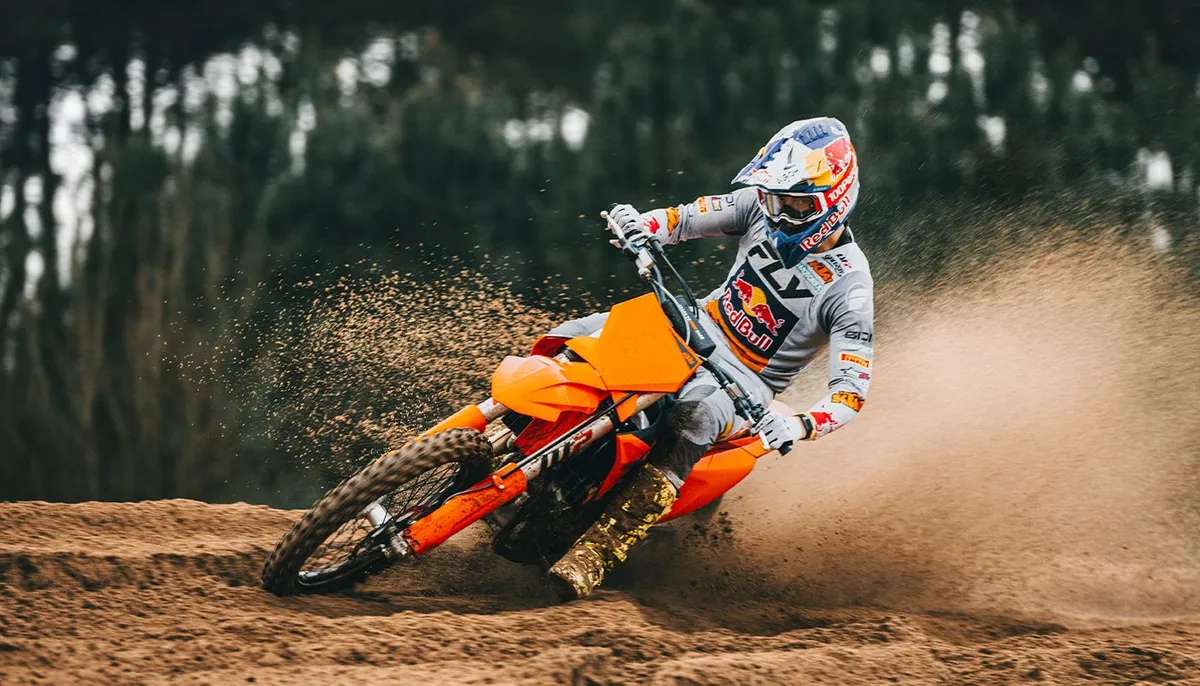
2027 KTM Motocross Range: The Big Changes, What's Better and Who Actually Needs Them?
KTM has given its 2027 motocross range a serious technical overhaul, with revised frames, updated engine positioning, new chassis characteristics and a major push to make its two-strokes more sophisticated. But there is an important question behind all the technology: will the average motocross rider actually notice the difference, or are these improvements primarily aimed at the professionals?
KTM is calling the 2027 line-up the next step in its motocross development, and unlike a simple graphics-and-suspension update, the Austrian manufacturer has made changes to the fundamental motorcycle.
The 2027 range includes the 450 SX-F, 350 SX-F and 250 SX-F four-strokes, alongside the 300 SX, 250 SX and 125 SX two-strokes. KTM also continues its youth motocross range with the 85 SX in two wheel-size configurations, the 65 SX and 50 SX.
There is also a particularly interesting development for two-stroke fans. KTM describes the new SX two-strokes as taking the traditional motocross formula further into the modern era with fuel injection, electric starting and electronic rider aids.
That makes the 2027 KTM range one of the more significant developments in the motocross market, particularly because KTM isn't simply trying to make the bikes faster.
It is trying to make them easier to control while still giving professional riders the performance ceiling they need.
The 2027 KTM Motocross Range at a Glance
| Model | Engine | UK Base Price | My Take |
|---|---|---|---|
| KTM 450 SX-F | 450cc 4-stroke | £8,649 | Maximum performance |
| KTM 350 SX-F | 350cc 4-stroke | £8,199 | Best all-round race option |
| KTM 250 SX-F | 250cc 4-stroke | £7,849 | Strongest choice for many racers |
| KTM 300 SX | 300cc 2-stroke | £7,949 | Most interesting two-stroke |
| KTM 250 SX | 250cc 2-stroke | £7,699 | Raw and aggressive |
| KTM 125 SX | 125cc 2-stroke | £7,049 | Best for learning race technique |
KTM's UK website currently lists these base prices as including VAT, delivery to dealer and PDI.
The Biggest Change: KTM Has Altered the Chassis Philosophy
The most important part of the 2027 KTM story isn't actually the engine.
It is the chassis.
KTM says the SX and SX-F machines receive revised frame development based on input from its Factory Racing programme. The area around the rear shock mount has been redesigned, with changes to engine mounting points and frame cut-outs intended to alter the way the chassis flexes. The front section of the frame also receives revised wall thickness and engine-mount changes.
That may sound like something only a factory rider should care about.
I disagree.
Chassis behaviour affects every rider. The difference is that a professional is much more capable of exploiting a small change in flex, while a novice may simply experience it as a motorcycle that feels different underneath them.
Why KTM is doing this
Modern motocross bikes are already incredibly stiff and capable. The challenge is no longer simply making a frame stronger.
The challenge is making it flex in the right places, at the right time and in a predictable way.
That can influence how the bike behaves when landing from a jump, entering a rut, accelerating out of a corner or hitting braking bumps at speed.
For a factory-level rider, those characteristics can be tuned obsessively.
For an everyday rider, the benefit should be a motorcycle that feels less nervous and more predictable when the track becomes rough.
But there is a potential downside.
A chassis developed around professional-level riding isn't automatically perfect for a 75kg weekend rider.
That is something buyers need to remember when they see the words "Factory Racing" attached to a production bike.
The Four-Strokes Get a Major Engine Position Change
One of the more significant technical changes to the SX-F platform is the engine position.
KTM has tilted the SX-F engine two degrees backwards, with the objective of improving mass centralisation and reducing the effect of the engine's weight on the motorcycle's overall handling. KTM also links the change to anti-squat behaviour.
This is the sort of engineering change that could have a much bigger effect than a small horsepower increase.
Why?
Because motocross isn't just about how much power the engine produces.
It is about where the weight sits while the bike is accelerating, braking, cornering and changing direction.
Moving the engine's position changes the relationship between the mass of the engine, the chassis and the suspension.
For an expert rider, that could make the bike easier to place precisely.
For a novice, it should theoretically make the bike feel more composed, although the rider is unlikely to be able to explain exactly why.
The 450 SX-F: Still the Heavyweight KTM
The 2027 KTM 450 SX-F remains the flagship four-stroke motocross machine.
KTM lists the UK base price at £8,649, including VAT, dealer delivery and PDI.
The motorcycle retains KTM's 450cc SOHC engine, with a claimed engine weight of just 26.8kg. It also gets the company's familiar electronic package, including two engine maps, traction control, launch control and Quickshifter.
For the pro
This is where the 450 makes the most sense.
A professional rider can actually use the engine's performance rather than simply surviving it.
The revised chassis and engine positioning should also make it easier for a high-level rider to exploit the power without the motorcycle feeling like it is constantly trying to dictate where it wants to go.
That is the important distinction.
The best 450 isn't necessarily the one with the most horsepower.
It is the one that lets an elite rider use the horsepower for an entire race.
For the everyday rider
This is where I would be more cautious.
A 450 SX-F is still a serious motorcycle.
Even with traction control, selectable maps and launch control, it doesn't suddenly become a beginner-friendly bike.
For an experienced amateur, however, the 2027 changes could make the 450 more manageable.
My verdict: outstanding for experts, unnecessary for most casual riders.
The 350 SX-F Could Be the Sweet Spot
The KTM 350 SX-F remains one of the most interesting motorcycles in the entire range.
KTM currently lists the 2027 model at £8,199 in the UK.
The attraction of the 350 is obvious.
It gives the rider more engine than a 250 without demanding the same level of physical commitment as a 450.
That makes it potentially more useful to a very wide range of riders.
A professional can keep the engine screaming and extract serious performance from it, while a veteran or experienced club rider can use the extra torque without constantly fighting a 450.
Of all the four-strokes, this is the bike I think has the strongest argument outside professional racing.
It isn't slow.
It isn't overwhelming.
And it gives an experienced rider room to grow.
The 250 SX-F: Probably the Most Important Bike in the Range
The KTM 250 SX-F is priced at £7,849 in the UK for 2027.
KTM describes it as a motorcycle designed to work for everyone from novice to professional, while still retaining genuine race performance.
That claim actually makes sense.
A 250 four-stroke forces the rider to carry speed.
You cannot simply rely on huge torque to get you out of a bad corner.
That can be frustrating when you're learning, but it is also an excellent way to improve technique.
You learn to brake later, carry momentum, select the correct gear and keep the engine working.
For a professional, that same characteristic becomes a weapon.
The 250 SX-F rewards commitment rather than rescuing poor technique.
For that reason, I think it remains one of the most important motorcycles KTM sells.
The Two-Stroke Story Is Even More Interesting
If the four-strokes represent KTM's pursuit of chassis refinement, the two-strokes show just how far the company is willing to modernise a traditionally simple category.
KTM says the SX two-strokes now combine fuel injection, electric starting and electronic rider aids with the traditional two-stroke characteristics.
That is significant.
Because the traditional argument for buying a two-stroke has always been simplicity.
Less weight.
Fewer moving parts.
Simple mechanical character.
But KTM is effectively saying that modern technology doesn't have to destroy the appeal of the two-stroke.
It can make the bikes easier to use while keeping the aggressive, lightweight character riders actually buy them for.
KTM 300 SX: The Bike That Could Shake Up the Two-Stroke Market
The 300 SX is arguably the most interesting motorcycle in the 2027 KTM range.
KTM lists the UK price at £7,949.
The reason it interests me isn't simply the size of the engine.
It is what a 300 two-stroke represents in a motocross market traditionally dominated by 250 two-strokes and 450 four-strokes.
KTM describes the 300 SX as a machine focused heavily on power-to-weight performance and says its development has been influenced by Factory Racing experience.
For an expert rider, a 300 two-stroke can offer a fascinating combination of strong acceleration and relatively low engine mass.
For an ordinary rider, however, I think the question is whether you actually need it.
A 300 can be exciting.
But exciting isn't always the same as fast.
If the rider cannot control the engine's output, a 250 SX or 250 SX-F may actually be easier to ride quickly.
This is a bike I'd recommend to an experienced rider rather than someone moving into motocross for the first time.
The 250 SX: The Raw Option
The 2027 KTM 250 SX costs £7,699 in the UK, making it cheaper than the equivalent 250 SX-F.
The 250 SX remains the raw two-stroke option.
There is no hiding behind a broad four-stroke torque curve.
You have to manage the engine, carry speed and use the gearbox properly.
For an expert rider, that can be incredibly rewarding.
For a novice, it can be a steep learning curve.
But that isn't necessarily a bad thing.
There is an argument that modern motorcycles have become so capable that they can hide mistakes.
A two-stroke 250 doesn't always do that.
It demands input from the rider.
And Then There's the 125 SX
The KTM 125 SX is listed at £7,049 for 2027 in the UK.
This is probably the motorcycle in the range that I would choose if my primary goal was to improve riding technique rather than simply chase lap times.
KTM itself emphasises the role of two-stroke riding in developing throttle control, corner speed, body position, gear selection and aggression.
And I agree with the basic philosophy.
A 125 forces you to work.
You cannot simply twist the throttle halfway down a straight and expect the engine to drag you towards the next corner.
You need momentum.
You need to be in the right gear.
You need to carry speed through corners.
For a young rider or developing racer, those skills are invaluable.
For a veteran rider looking for an easy Sunday bike, the 125 might be a lot more work than they want.
The Electronics Are Becoming Normal on Motocross Bikes
The 2027 KTM SX-F models continue with two engine maps, traction control, launch control and Quickshifter. KTM says the launch system works by limiting rear-wheel power to improve traction under hard acceleration, while the Quickshifter allows clutchless upshifts.
This is where the gap between professional and everyday riders becomes particularly interesting.
Professionals will use them as tuning tools
A factory rider can use electronics as part of a much larger setup strategy.
Track conditions change.
So does the amount of grip.
A hard-packed track in the morning can become deep and rutted by the afternoon.
Having the ability to change the engine response gives the rider another way of adapting the motorcycle.
Most amateurs will probably use one setting
For the average club rider, however, I suspect many of these features will be used much less frequently.
There is nothing wrong with having them.
But technology can create the illusion that the motorcycle needs constant adjustment.
Sometimes the biggest improvement is simply learning how to ride the bike better.
The electronics are an advantage. They aren't a substitute for technique.
Suspension: Where the 2027 KTM Could Make the Biggest Difference
KTM continues to use WP XACT suspension, including 48mm XACT AER air forks and an XACT rear shock, with the suspension designed around the revised chassis. KTM says the fork combines an air spring with a pressurised oil chamber and mid-valve damping, while the rear shock uses settings derived from its Factory Racing development.
The important point is adjustability.
KTM provides accessible suspension adjustment, including fork clickers and rear high- and low-speed compression adjustment.
That is fantastic for experienced riders.
It is potentially confusing for novices.
If you know what you're changing, you can make the bike work considerably better for your weight and riding style.
If you don't, you can easily make it worse.
That is one of the biggest hidden differences between a professional and a weekend rider.
The professional sees adjustable suspension as a weapon. The novice can see it as another problem to solve.
The Ergonomics Have Been Reworked Too
KTM has also worked on the relationship between the rider and the motorcycle.
The company says its revised tank shrouds improve airflow towards the radiators, while the tank shape and rider triangle are intended to provide better knee contact and gripping surfaces, particularly when standing.
This is another change that should benefit practically everybody.
You don't need to be a factory rider to appreciate a motorcycle that is easier to grip with your knees.
In fact, I would argue that this could be more noticeable to an amateur than a small engine-performance gain.
A rider who can move around the motorcycle without fighting the plastics and tank is likely to feel more comfortable and less fatigued.
What's Good About the 2027 KTM Motocross Range?
- Major chassis development: KTM has worked on frame flex rather than simply changing graphics.
- Improved engine positioning: The four-stroke engine has been tilted two degrees backwards to influence mass centralisation and handling.
- Excellent electronics: Map selection, traction control, launch control and Quickshifter give racers plenty of options.
- Modern two-strokes: KTM continues pushing fuel injection, electric start and electronics into the SX two-stroke platform.
- Strong model choice: From the 125 SX through to the 450 SX-F, there is a bike for almost every type of motocross racer.
- 350 SX-F remains highly attractive: It offers a middle ground that makes sense for many experienced riders.
- 125 SX remains relevant: It still encourages riders to develop fundamental skills rather than relying on horsepower.
- Suspension adjustability: The WP package gives experienced riders plenty of scope to tune the motorcycle.
- Race-focused ergonomics: KTM has clearly concentrated on rider movement and control.
What's Bad About the 2027 KTM Range?
The biggest problem isn't really the motorcycles.
It's how much capability KTM is putting into bikes that many riders will never fully exploit.
The price
At £8,649 for the 450 SX-F, £8,199 for the 350 SX-F and £7,849 for the 250 SX-F, new KTM motocross bikes are serious financial purchases.
The 250 SX is £7,699 and the 125 SX £7,049, so even the entry points into KTM's full-size SX range are not cheap.
That matters because motocross is already an expensive sport.
Tyres, fuel, maintenance, suspension servicing, engines, plastics, chains, sprockets and race entry fees all add up.
A rider buying a new bike doesn't simply need to afford the motorcycle.
They need to afford everything that comes afterwards.
The technology increases complexity
Fuel injection, electronic controls, electric starting and advanced engine management are convenient, but they also mean more technology is involved in keeping the motorcycle operating correctly.
That isn't automatically a reliability problem.
But it does move the modern motocross bike further away from the simplicity that originally made two-strokes so attractive.
Factory-inspired doesn't mean factory-perfect for you
This is probably my biggest criticism of modern motocross marketing generally.
A suspension setting developed with a professional rider doesn't automatically mean it is ideal for a 90kg amateur.
A frame designed around factory racing doesn't automatically make you faster.
And a 450 with traction control isn't suddenly a beginner bike.
The rider still matters more than the motorcycle.
How Will the 2027 KTM Changes Affect the Everyday Rider?
For the average rider who spends weekends at a local track, I think the biggest benefits will come from chassis stability, rider ergonomics, suspension adjustability and controllable engine characteristics.
You are unlikely to suddenly find two seconds a lap because the engine has been repositioned.
But you might find that the bike feels more settled through rough corners.
You might feel more comfortable standing.
You might find it easier to keep the bike straight through braking bumps.
And you may appreciate the ability to soften or sharpen the engine response depending on conditions.
Those are the improvements that matter to ordinary riders.
How Will They Affect Professional Riders?
The professional gains are different.
At the top level, riders are already operating at the limit of what the motorcycle can provide.
When you're racing at that level, a small change in chassis behaviour can affect confidence.
A slightly different engine response can change how aggressively a rider attacks a corner.
A different anti-squat characteristic can alter how the rear of the bike behaves under acceleration.
And the ability to make those characteristics work with suspension settings, electronics and rider setup is where the real performance gain appears.
The 2027 KTM is therefore less about giving the professional a dramatically faster engine and more about giving them a more sophisticated tool.
Could This Change the Motocross Market?
I think it could, particularly in the two-stroke market.
KTM is effectively normalising the idea that a two-stroke can have the technology previously associated with four-strokes.
Fuel injection, electric start and electronic rider aids make the traditional two-stroke ownership experience more accessible without completely abandoning the characteristics that attract riders to the bikes in the first place.
That puts pressure on other manufacturers.
Yamaha has maintained its two-stroke presence in a different way, while brands such as GasGas and Husqvarna share much of the broader KTM Group technology philosophy.
But the interesting question is what happens if riders begin to expect modern electronics and easier starting from their two-strokes.
Suddenly, a manufacturer selling a technically simple two-stroke could start to look old-fashioned rather than authentic.
That could accelerate development across the entire category.
The 300 SX Could Create Its Own Niche
I also think the 300 SX is strategically interesting.
It doesn't fit neatly into the traditional 125/250 two-stroke motocross progression.
But that's precisely why it could attract riders who want something different.
There is a growing market for riders who don't necessarily care about fitting perfectly into a traditional race class. They want a bike that is exciting, powerful and relatively light.
The 300 SX gives KTM a product for that rider.
Whether it becomes a major volume seller is another question.
But it gives KTM something most competitors cannot simply ignore.
Which 2027 KTM Would I Buy?
If I were buying purely for racing, my answer would depend on the rider.
For a professional: 450 SX-F
If you're competing at the highest level and have the fitness and technique to exploit it, the 450 SX-F remains the obvious weapon.
For an experienced amateur: 350 SX-F
This would probably be my choice for the widest range of experienced riders.
You get serious performance without taking on all of the physical demands of a 450.
For developing racers: 250 SX-F
If your goal is to become a better motocross rider, the 250 four-stroke is difficult to ignore.
It rewards speed, precision and momentum.
For experienced two-stroke riders: 300 SX or 250 SX
The 300 SX is the more unusual proposition, while the 250 SX remains the classic aggressive two-stroke choice.
For developing young riders: 125 SX
If you're trying to build racecraft, the 125 SX makes a huge amount of sense.
It forces the rider to learn the fundamentals.
My Verdict on the 2027 KTM Motocross Range
I think KTM has taken the right approach with the 2027 range.
The company could have simply chased more horsepower, but instead it has concentrated heavily on the chassis and the relationship between the engine and the frame.
That is the smarter route.
Modern motocross bikes already have enormous amounts of power.
The real challenge is making that performance usable.
The revised frame, altered engine positioning, revised ergonomics and sophisticated suspension package all point in the same direction: more control.
The two-stroke range is arguably even more interesting.
KTM is taking a category that has traditionally been associated with mechanical simplicity and bringing it firmly into the electronic age.
Some purists won't like that.
But for riders who want the lightness and character of a two-stroke without dealing with traditional carburettor jetting and kick-starting, the argument is much harder to dismiss.
The Biggest Winner Might Not Be the 450
There is a tendency to assume that the biggest and most expensive bike is automatically the star of a new motocross range.
I'm not convinced.
For professional racing, the 450 SX-F is still the headline machine.
For the average experienced rider, however, I think the 350 SX-F could be the real winner.
It sits in the part of the market where performance and usability overlap.
And that is increasingly important as motocross bikes become more powerful and more sophisticated.
Meanwhile, the 250 SX-F remains the bike I'd look at for someone serious about improving their racing, while the 125 SX continues to make a compelling case for developing genuine riding skills.
Final Thoughts
The 2027 KTM motocross range is not simply a new set of plastics wrapped around last year's motorcycles.
KTM has changed important parts of the SX and SX-F platform, including the frame characteristics, engine positioning, rider ergonomics and the way the two-strokes integrate modern electronic technology.
For professional riders, these changes could provide another layer of performance and adjustability.
For experienced club racers, the biggest benefit should be a motorcycle that is easier to exploit rather than simply more powerful.
For beginners, however, I would resist the temptation to assume that buying the most technologically advanced KTM automatically makes you a better rider.
It doesn't.
A 450 won't teach you to corner.
Traction control won't teach you throttle control.
Launch control won't teach you race starts.
And an expensive suspension package won't fix poor setup.
The biggest advantage of the 2027 KTM range is that it gives good riders an even better tool.
Now it is up to the rider to make the most of it.